EV Charger Installation guide
Does pairing your EV charger with rooftop solar actually pay off in Brisbane?
The Short Answer: Yes, Usually, But the Numbers Depend on When You Charge
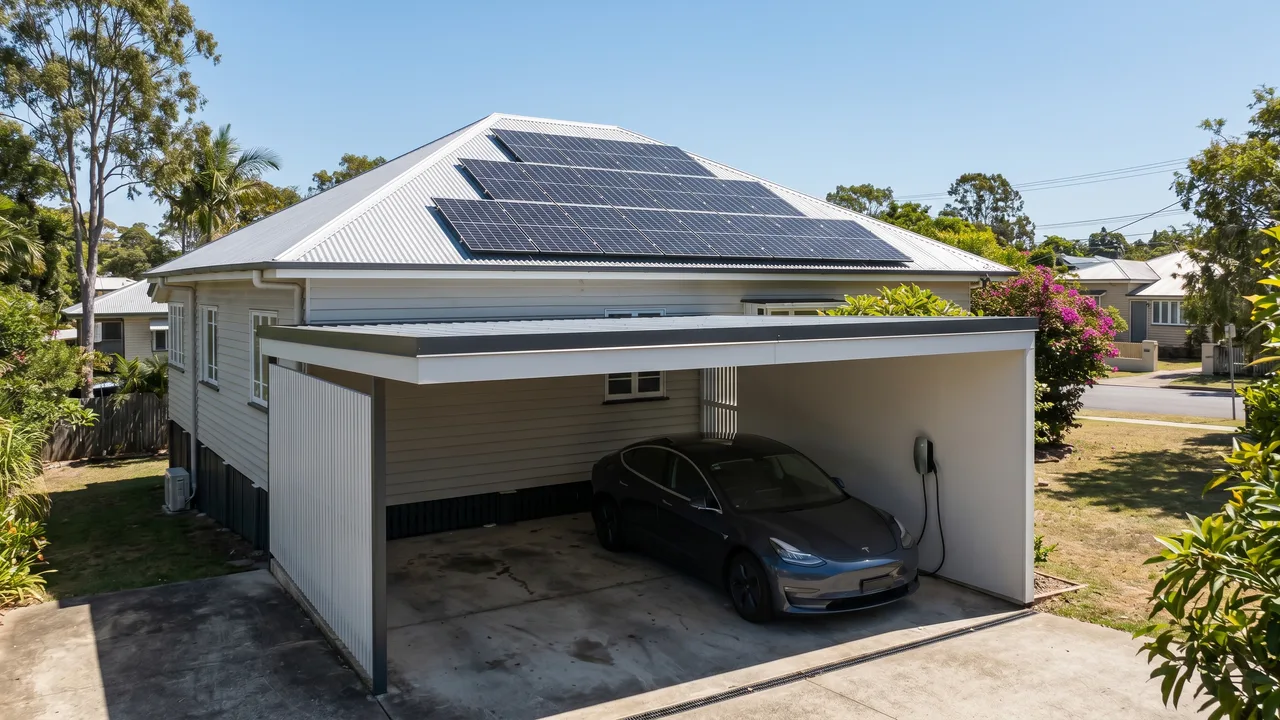
Pairing a home EV charger with rooftop solar genuinely does pay off for most Brisbane households, but not automatically. The payoff comes down to one thing: whether your car is parked at home during the day when your panels are actually generating.
If you commute by car and your driveway sits empty from 8am to 5pm, you can route a meaningful chunk of that generation directly into your EV instead of exporting it to the grid at a low feed-in tariff. If your car leaves early and comes back after sunset, the maths shift considerably.
What Your Solar System Is Actually Doing Right Now
Most Brisbane rooftop systems are sized between 6.6 kW and 13.2 kW these days. On a clear Brisbane summer day, a 6.6 kW system typically generates 25 to 30 kWh. Your household might consume 8 to 12 kWh of that during the day, which leaves a genuine surplus sitting there.
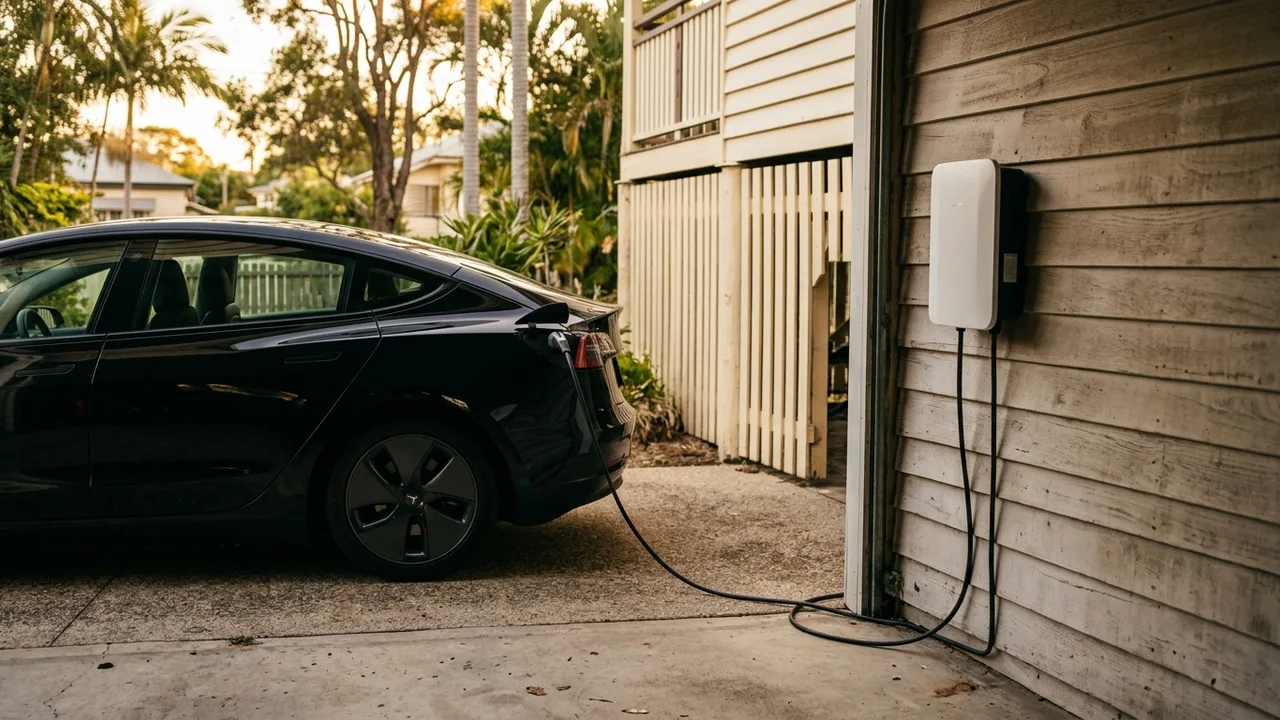
Until recently, most households exported that surplus and received a feed-in tariff. Current feed-in tariffs in Queensland generally sit somewhere between 5 and 10 cents per kWh, depending on your retailer and plan. Meanwhile, you are probably paying 28 to 35 cents per kWh when you draw power from the grid at night to charge your EV.
That gap, roughly 20 to 28 cents per kWh, is the financial engine behind solar EV charging. A mid-size EV with a 60 kWh battery that needs 15 kWh of top-up on a given day could save you $3 to $4 in electricity cost, on that single charge, compared with charging off the grid at peak time.
How a Solar-Integrated EV Charging Setup Actually Works
There is a spectrum of how "integrated" you can get, and each step up costs a bit more.
Basic time-of-day scheduling is the simplest option. You set your charger to run during daylight hours, say 9am to 3pm, on the assumption your panels are generating. No communication between the charger and the inverter. It works reasonably well if your schedule is consistent, but it charges at full rate regardless of whether the sun is shining or a storm has rolled in off Moreton Bay.
Solar-matched (dynamic) charging uses a smart EV charger that communicates with your inverter or a home energy management device. It reads your real-time surplus generation and throttles the charger up or down accordingly. If a cloud bank rolls over Camp Hill at noon, the charger slows down rather than pulling from the grid to compensate. This approach genuinely maximises solar use, but it requires a compatible inverter, a compatible charger, and correct installation of both.
Battery-buffered solar charging adds a home battery (like a Powerwall) into the loop. The battery stores your midday surplus and you charge the EV from that stored power in the evening. This solves the "car away during the day" problem and gives you more flexibility, but a home battery is a significant additional cost, typically $10,000 to $16,000 installed, and changes the payback calculation substantially.
When we set up solar-integrated EV charging for homes in Coorparoo, Greenslopes and surrounds, we assess which of these tiers actually suits the household before recommending hardware. A dynamic charging setup makes no sense if your inverter is not compatible or your roof faces west with afternoon shade from a neighbouring Queenslander.
The Inner West Brisbane Context You Should Factor In
A few things about this cluster of suburbs are worth acknowledging.
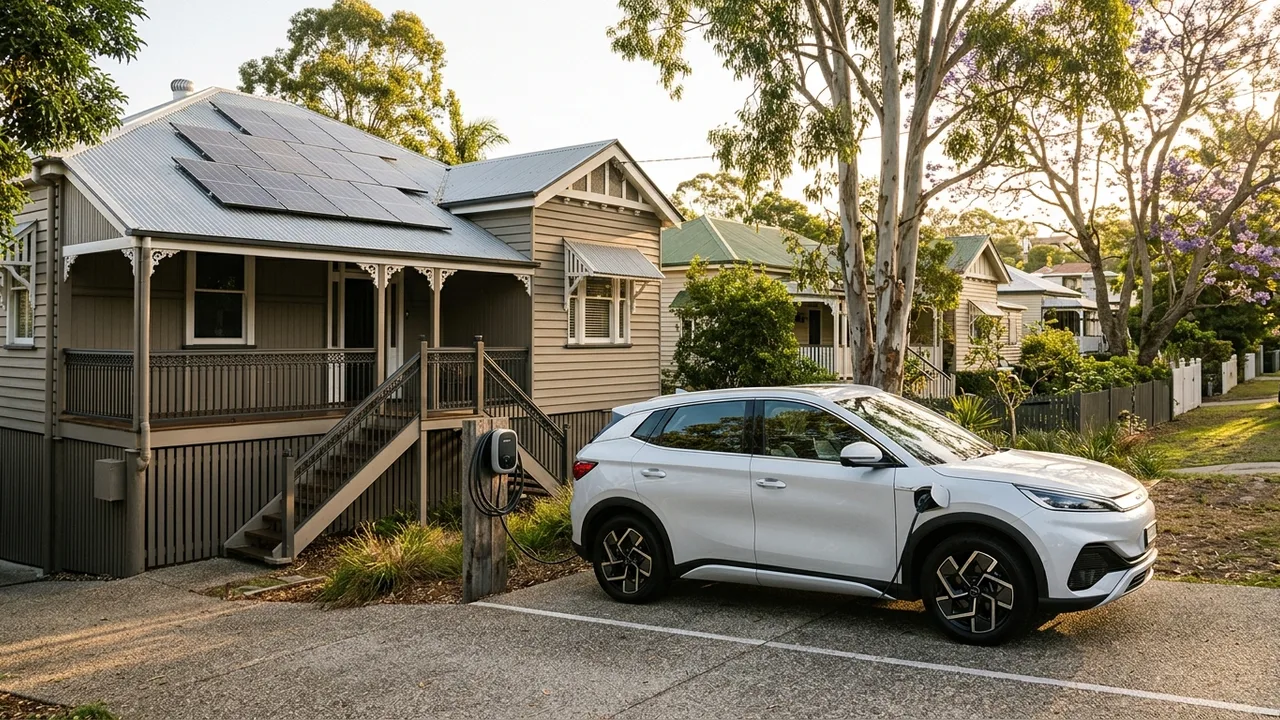
Roof orientation varies a lot here. Many older homes in West End, Highgate Hill and Woolloongabba sit on narrow lots with north-facing rooflines that are well suited to solar generation. But plenty of character homes in Coorparoo and Camp Hill have hipped roofs with mixed orientations, meaning their panels generate at different rates across the day. A system producing strongly from 10am to 2pm is ideal for daytime EV charging. One that peaks late afternoon is less so.
Jacaranda and large fig canopy shade is a real factor in streets like those through Annerley and Dutton Park. Partial shading during peak generation hours can cut actual output well below rated capacity. If your system already has microinverters or a DC optimiser on each panel to handle this, great. If it runs on a single string inverter with shade issues, the surplus you have to route to your EV may be smaller than you expect.
Townhouses and smaller blocks in the Kangaroo Point and East Brisbane area often have smaller roof space, which means smaller systems and less surplus. A 3 kW or 4 kW system on a townhouse may cover the household load but leave little spare capacity for consistent EV charging without drawing on grid power regardless.
Three-phase power is available on most streets through this cluster, and some households already have it. A three-phase EV charger can deliver 11 kW or 22 kW of charge speed, which matters less for solar-matched daytime charging (where you may only have 2 to 4 kW of genuine surplus to use) but matters a lot for full overnight charging.
Crunching the Numbers: A Realistic Example
Take a household in Coorparoo with a 10 kW solar system, an EV that needs roughly 50 kWh per week of top-up, and a family car that parks in the driveway from around 11am to 4pm on weekdays.
- Solar surplus available in that window: roughly 8 to 12 kWh per day in summer, 4 to 7 kWh in winter.
- Weekly solar EV charge possible (conservative estimate): 25 to 35 kWh.
- Grid top-up needed: 15 to 25 kWh per week.
- Saving versus charging entirely from the grid at 32 cents: roughly $8 to $11 per week.
- Annual saving estimate: $400 to $570.
That is not life-changing, but it is meaningful. Over five years it adds up to $2,000 to $2,850, and the solar-integrated charger setup itself typically costs $600 to $1,500 more than a basic charger install, depending on hardware and compatibility work required.
The payback on the solar integration premium is typically two to four years in a scenario like this one. If you are already spending $2,000 to $2,500 on a quality charger install and switchboard work, the incremental cost of going solar-integrated is modest relative to the ongoing saving.
Trade-offs Worth Being Honest About
Solar-integrated charging is not the right choice for every household. Here is where it may not stack up.
- If your car is away all day, you will export most of your surplus anyway. Time-of-day scheduling to charge at 9pm off a home battery makes more sense, but that requires the battery investment.
- If your solar system is ageing or undersized, it may not have consistent surplus to offer. An inspection of your existing system before adding an EV charger layer is worthwhile.
- If your inverter is not compatible with the smart charger you want, you may need an additional energy monitoring device, which adds cost and another point of potential failure.
- If you are renting, the decision is not yours alone and the capital outlay is harder to justify.
The straightforward grid-charge approach, just plugging in overnight on a sensible time-of-use tariff, is not a bad option. It is simpler, cheaper upfront, and still significantly cheaper than petrol. Solar integration is an upgrade worth pursuing, not a necessity.
What We'd Recommend
If you have rooftop solar already, are home during the day at least part of the week, and your system is in good working order, a solar-integrated EV charger setup is likely worth the extra investment. The gap between feed-in rates and retail electricity prices in Queensland makes it financially logical.
If you are starting from scratch without solar, installing an EV charger first and adding solar later works fine. Most quality charger installs can be reconfigured for solar integration once your panels are up.
The most useful thing you can do before committing to hardware is look at three months of your inverter's generation data (most modern inverters log this via an app) alongside your typical parking schedule. That picture will tell you more about your likely saving than any generic calculator.
If you want a straight answer about whether your specific setup in Coorparoo, Greenslopes, Camp Hill or nearby is a good candidate for solar-integrated charging, give us a call. We will tell you honestly if it stacks up for your home.
Quick answers