EV Charger Installation guide
Queenslander homes make EV charger wiring harder — here is why
Queenslander homes are harder to wire for an EV charger because the structure itself works against you. The combination of elevated timber frames, sub-floor voids, no internal wall cavities, and switchboards that are often decades old creates a set of obstacles you simply don't face in a brick-veneer home built in the last twenty years. If you live in Coorparoo, Camp Hill, West End or anywhere else in Brisbane's Inner West, there's a good chance your house is a Queenslander or a post-war chamferboard variant that shares most of the same headaches.
Here's what's actually going on, and what it means for your installation.
The structure that makes everything complicated
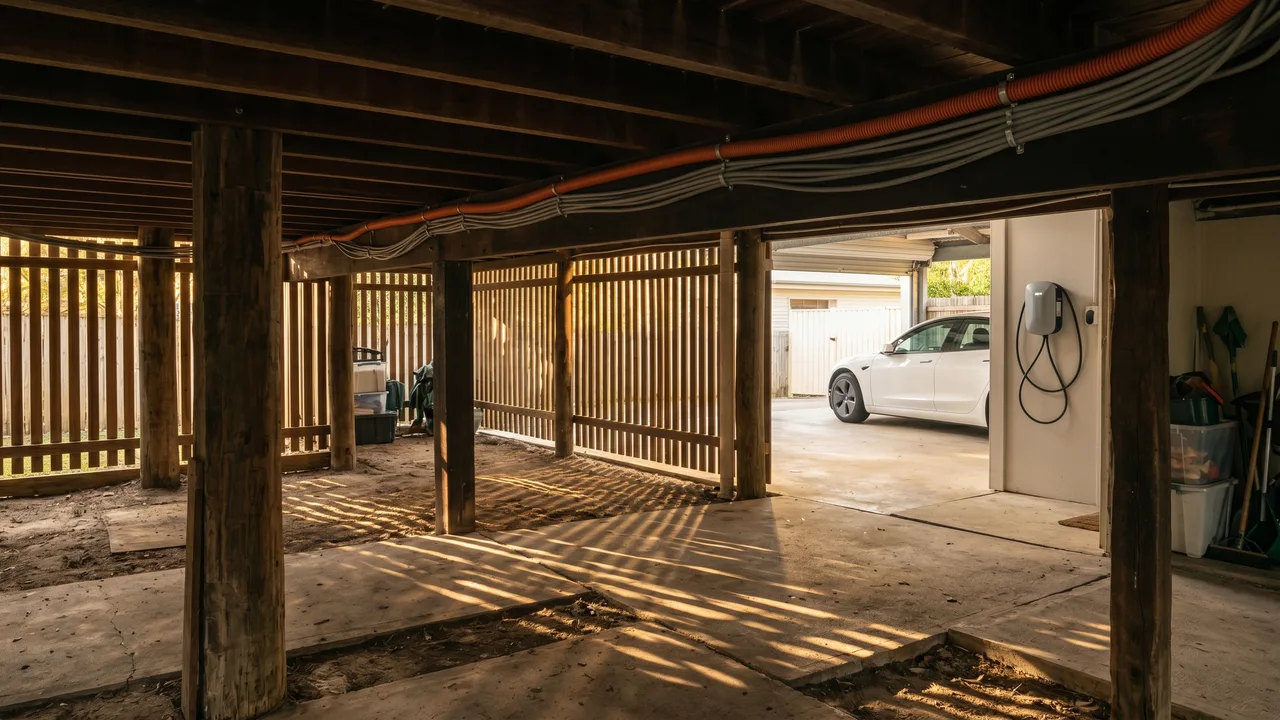
A traditional Queenslander sits on stumps, with the living area elevated anywhere from 600 mm to two metres off the ground. That sub-floor void sounds like a convenience for running cable, and in some ways it is. The problem is what the cable has to connect to.
Your driveway and carport are almost always at ground level. Your switchboard is typically mounted on an external wall, sometimes at ground level, sometimes elevated with the house. Running a dedicated circuit from the switchboard out to where the car parks sounds simple until you map the actual path: up through the floor, across a room or verandah, down through the wall or a post, under the house, back up to a weatherproof enclosure near the car. That cable run can easily reach 15 to 25 metres in a house that would be a 5-metre job in a post-2000 brick home.
Cable length matters because voltage drop matters. Australian wiring rules (AS/NZS 3000) set limits on how much voltage you can lose between the switchboard and the end point. A longer run on a 32-amp circuit may require a heavier cable gauge (typically 6 mm² instead of 4 mm²) to stay within that limit. Heavier cable costs more and is harder to thread through tight spots.
Switchboards that were never designed for this load
Most Queenslanders in suburbs like Highgate Hill, Dutton Park, Woolloongabba and Annerley were built between the 1910s and 1950s. The original switchboards, if they haven't been updated, often use ceramic fuses rather than modern circuit breakers, and they have no residual current devices (RCDs). Queensland's electrical safety rules and the charger manufacturer's installation requirements will not allow you to connect an EV charger to a board like that. Full stop.
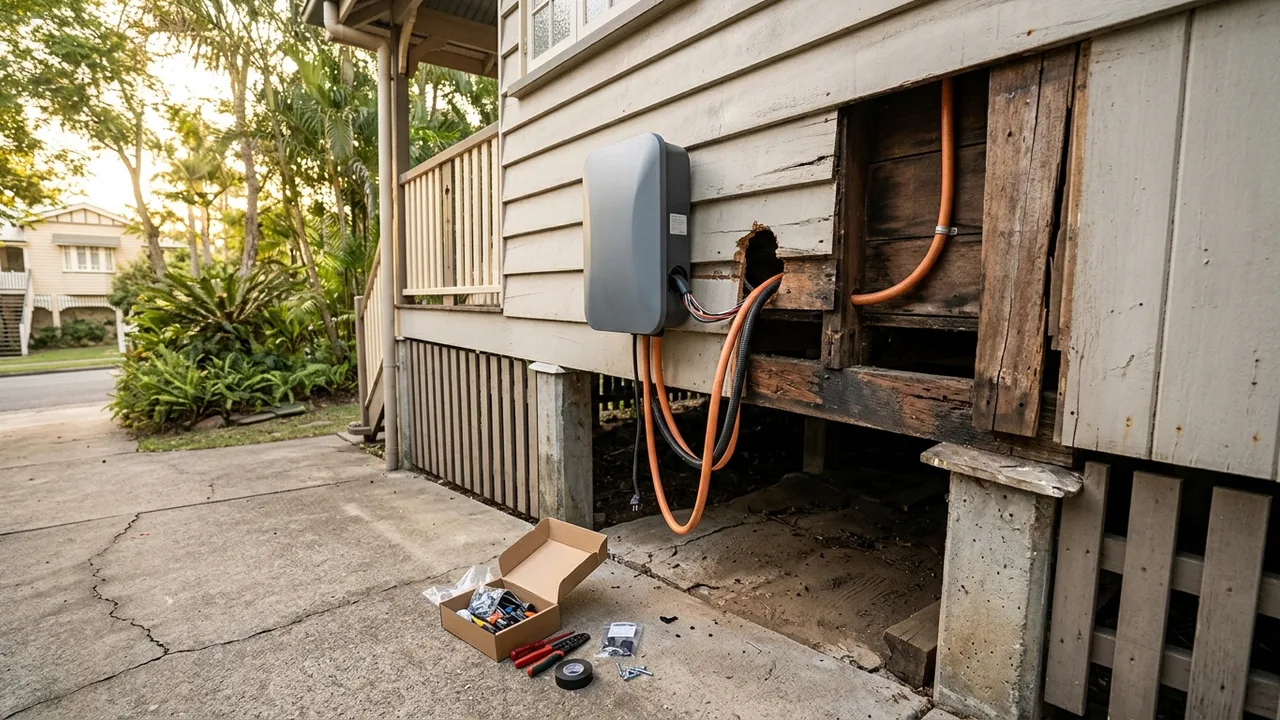
Even a board that was upgraded in the 1980s or 1990s may fall short. Single-phase boards from that era were typically rated for the loads of the time: a stove, a hot water system, a few power circuits. An EV charger running at 7.2 kW draws around 32 amps continuously. That is a sustained load unlike almost anything else in the house. Older boards may not have a spare breaker slot, may lack a suitable RCD arrangement, or may simply be at capacity.
What this means practically is that a switchboard upgrade is often part of the job, not a separate optional extra. We include a switchboard assessment in every quote we provide, because discovering a compliance issue mid-job is expensive for everyone.
The earthing question that catches people off guard
Older Brisbane homes on timber stumps often have earthing arrangements that don't meet current requirements for an EV charger installation. An EV charger requires a low-impedance earth path to operate safely and to satisfy AS 3000. Some Queenslanders still rely on a single earth stake driven into the soil near the meter box, which may be adequate for general household circuits but can be marginal for a dedicated high-current EV circuit.
A licensed electrician will test earth loop impedance as part of the installation process. If it doesn't pass, an additional earth electrode or MEN (Multiple Earthed Neutral) work is required before the charger can be safely commissioned. This isn't anyone's fault; it's just a consequence of wiring standards evolving over sixty or seventy years.
Where the charger actually goes on a Queenslander block
This is where local knowledge matters. In Coorparoo, Greenslopes and East Brisbane, a lot of Queenslander blocks are steep, with the carport accessed from a side street or sitting at the lowest point of the block. The charger itself needs to go somewhere weatherproof, accessible, and within a reasonable cable run of the board.
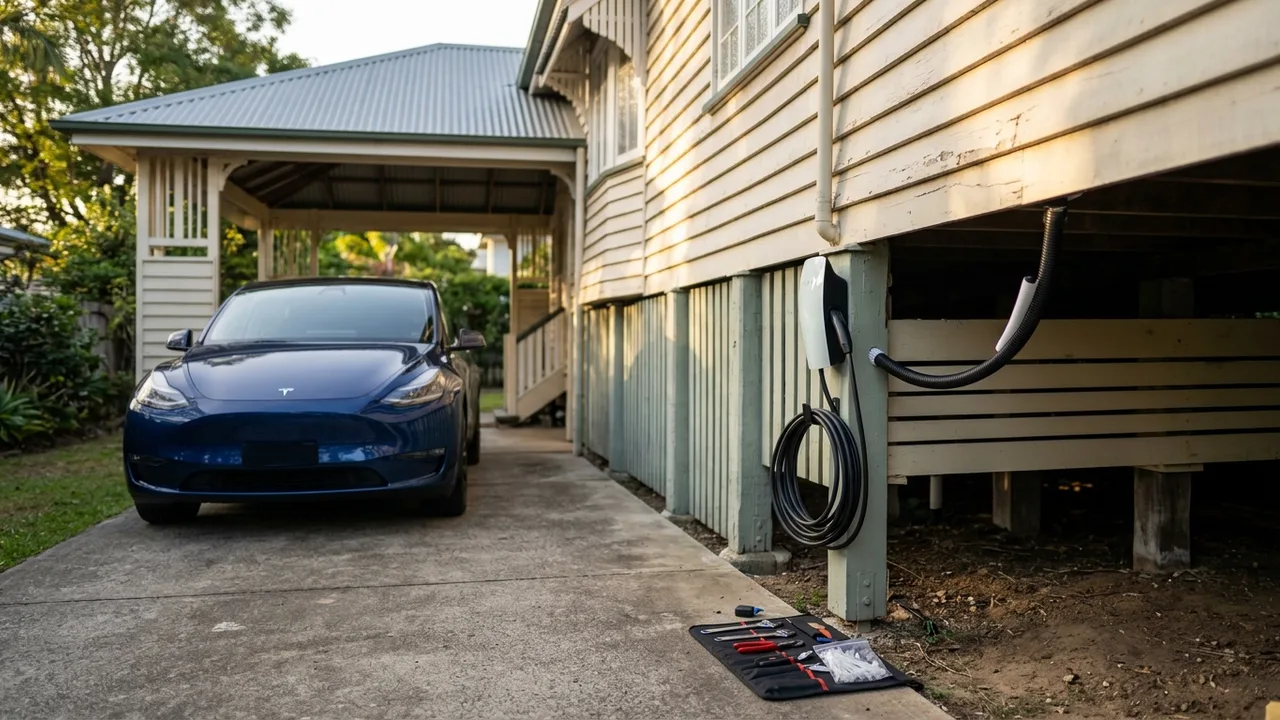
On a steeply sloping block, the sub-floor void under the house can be a viable cable route if there's enough clearance for the cable to be supported and protected. In some houses, though, the sub-floor has been enclosed with lattice or cladding, infilled as a granny flat, or is too low to access. In those cases, the cable route goes external: clipped to the wall, run in conduit, and exposed to weather and the occasional adventurous brush turkey.
The choice of route affects both cost and aesthetics. Surface-mounted conduit is quicker and cheaper to install but more visible. A concealed run through the sub-floor takes longer and sometimes requires a second person to thread cable, but it looks cleaner. We can usually give you both options with pricing at the quote stage so you can decide what matters more to you.
Three-phase versus single-phase: is it worth upgrading?
Most Queenslanders in Inner West Brisbane are on single-phase supply, which caps your charger at around 7.2 kW. That's roughly 40 kilometres of range per hour of charging for a typical electric car. For most people who drive 30 to 60 km a day, that is more than enough overnight.
Three-phase supply allows chargers up to 22 kW, which is genuinely useful if you have a large-battery vehicle (80 kWh or more), charge infrequently and need a full charge quickly, or have two EVs sharing a single charger. The trade-off is cost. A three-phase upgrade from Energex (Brisbane's distributor) involves a new service connection, a new switchboard, and the associated installation labour. In a Queenslander, add the cable run complexity described above. The total cost for a three-phase upgrade plus charger installation typically sits between $3,500 and $5,500 depending on your specific setup. For most single-car households, single-phase is the sensible starting point.
What to budget and what to watch out for
For a straightforward single-phase Queenslander installation in suburbs like Kangaroo Point, Tarragindi or Camp Hill, a realistic budget is $2,000 to $3,500. That range covers a modern wall-mounted charger, a dedicated 32-amp circuit, basic switchboard work if needed, and a standard sub-floor or external cable run of up to 20 metres.
The number climbs if you need a full switchboard replacement (add $800 to $1,500 typically), additional earthing work (add $200 to $500), or an unusually long or complicated cable route.
Be cautious of quotes that seem low and don't include a site visit or switchboard inspection. Queenslander installs have enough variables that a quote done sight-unseen often misses something. We don't quote Queenslander jobs without at least a photo assessment of the switchboard and the proposed cable route, and most jobs warrant a short site visit.
Our honest recommendation
If you own a Queenslander in Brisbane's Inner West and you're planning to buy an EV, or you've already bought one, get an electrical assessment done before you commit to a specific charger model or a specific installer quote. The assessment should cover the switchboard condition, the earthing arrangement, and the cable route options. None of that is complicated, but skipping it leads to surprises on installation day.
A good installation in a Queenslander takes longer than the same job in a modern home. That's normal, not a red flag. What you want to see is a quote that reflects the actual complexity of your specific house rather than a templated price that assumes everything is easy.
If you're in Coorparoo, West End, Camp Hill, Annerley or any of the suburbs nearby, we're happy to take a look and give you a straight answer on what your place actually needs.
Quick answers