EV Charger Installation guide
When does installing an EV charger mean your switchboard has to go too?
When Does Installing an EV Charger Mean Your Switchboard Has to Go Too?
Not always — but more often than most people expect. If your switchboard is older than roughly 15 years, has ceramic fuses instead of circuit breakers, or is already close to capacity, adding an EV charger circuit almost certainly means replacing it at the same time. Here is how to work out which camp you are in.
What an EV Charger Actually Asks of Your Electrical System
A standard home EV charger (typically a 7.2 kW single-phase unit) draws around 32 amps continuously for hours at a time. That is a very different load from a kettle or even an air conditioner, which cycle on and off. Your electrical system needs to sustain that draw safely, night after night.
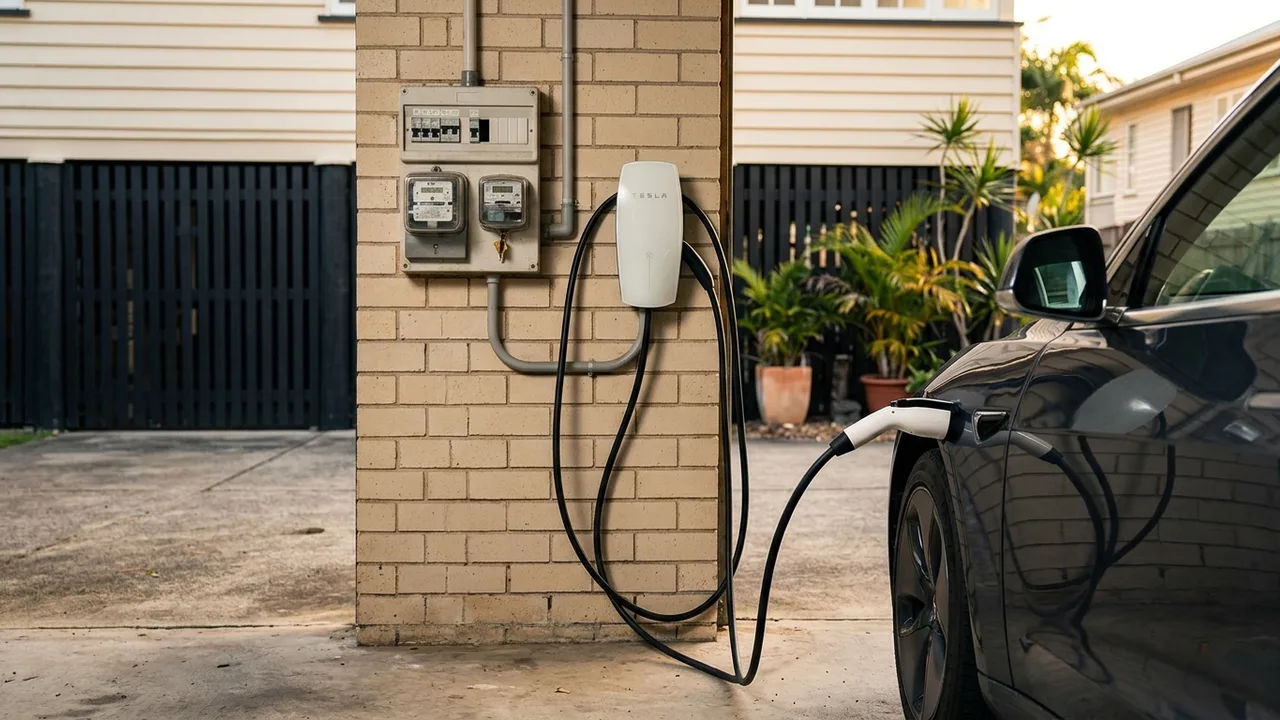
The charger needs its own dedicated circuit: a run of cable from the switchboard to the wall-mounted unit, protected by its own circuit breaker. That circuit breaker has to fit inside your switchboard. If there is no spare slot, or if the board itself is not rated for the additional load, something has to change before the charger goes in.
Three things typically determine whether the switchboard survives the upgrade:
- Age and type of the board (fuse-based vs. circuit-breaker-based)
- Remaining capacity (how many amps are already committed across active circuits)
- Earthing and safety switch coverage (older boards often lack residual current devices on every circuit, which Queensland regulations now require on new work)
The Old Fuse Board Problem (Especially Common in Coorparoo and Surrounds)
The Inner West suburbs of Brisbane have a lot of character homes. Queenslanders, post-war brick-and-tile, fibro cottages that have been renovated but not fully rewired. In Coorparoo, Camp Hill, Annerley, Tarragindi and West End, it is genuinely common to find a switchboard that has not been touched since the 1980s or earlier.
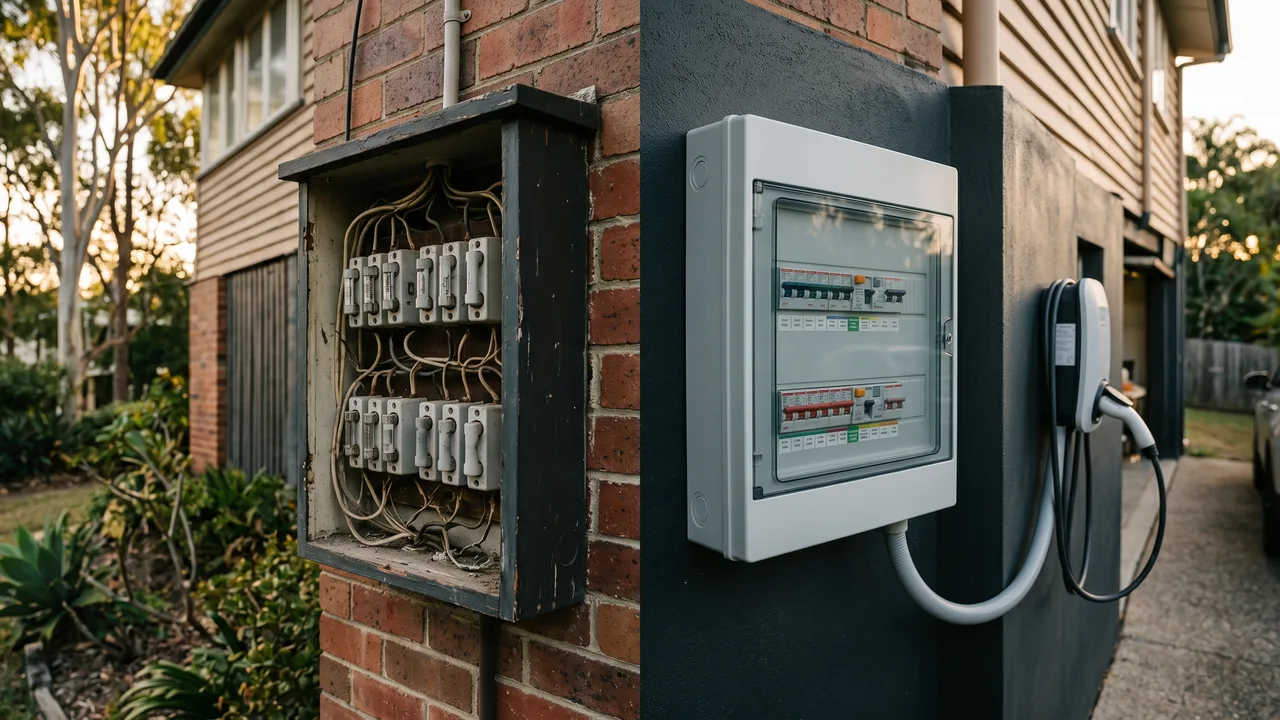
These boards typically have ceramic or porcelain rewirable fuses rather than modern circuit breakers. They were designed for a load profile that did not include ducted air conditioning, EV chargers, or solar inverters. Adding a 32-amp circuit to one of these boards is not just a matter of finding a spare slot: the whole board is essentially incompatible with modern electrical safety standards for new work.
A licensed electrician cannot legally sign off on a new high-load circuit connected to a board in that condition. The Board replacement is not upselling; it is a code requirement.
Even if you have a more modern board, check whether it has safety switches (residual current devices, or RCDs) covering every circuit. Under AS/NZS 3000 and Queensland's Electrical Safety Act, any new work has to meet current standards. If your board's earthing or RCD coverage is deficient, the electrician doing the EV charger installation has an obligation to bring those elements up to standard as part of the job.
How to Read Your Own Switchboard Before You Call Anyone
You do not need to be an electrician to gather useful information. Here is what to look for:
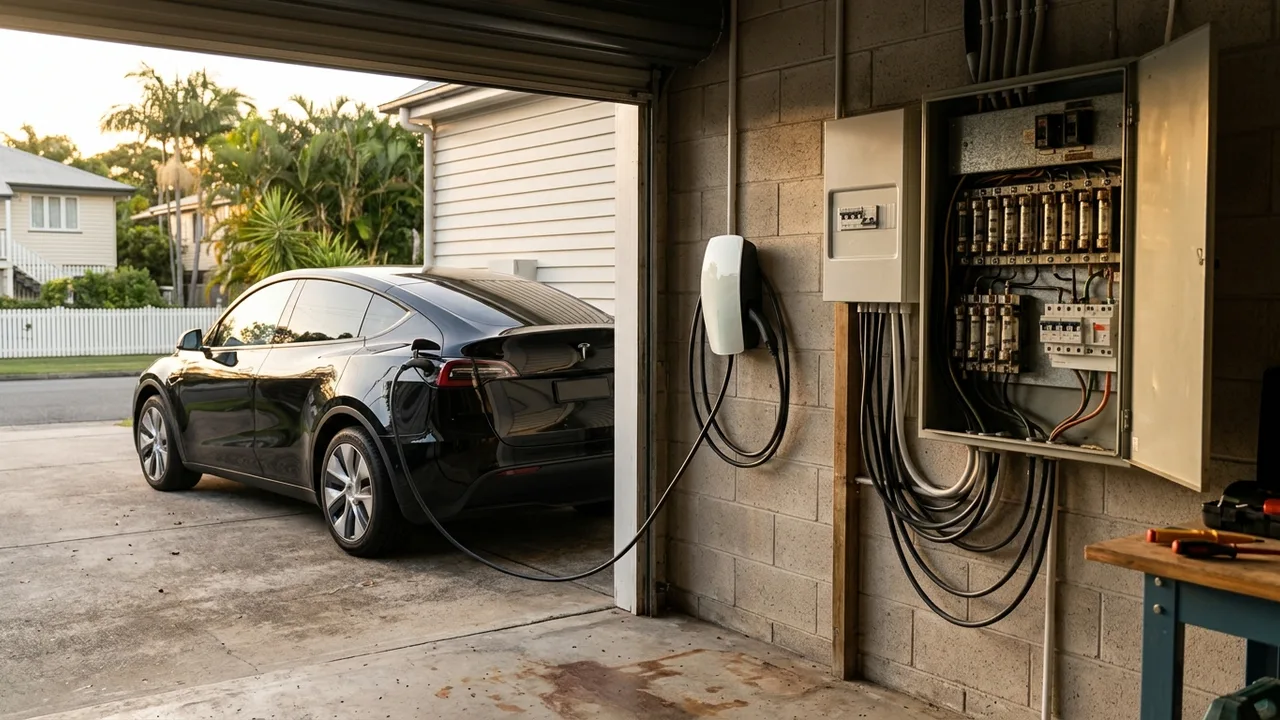
- Open the board cover (the outer door only, not the internal panel). Do you see circuit breakers (small switches with toggle levers) or ceramic fuse carriers (cylinder-shaped inserts that pull out)?
- Count the spare slots. A board with every slot occupied has no room for a new circuit without an upgrade or a sub-board.
- Look for safety switch labels. RCDs or safety switches are usually wider than standard breakers and often labelled "RCD", "SAFETY SWITCH" or with a test button.
- Check the main switch rating. It is usually printed on the main switch itself. A 40-amp or 60-amp main in an older home may not have headroom for a dedicated 32-amp EV circuit.
If you find ceramic fuses, a fully populated board, or no safety switches, plan for a switchboard replacement. Get that expectation into your budget from the start.
What a Switchboard Upgrade Actually Costs and What You Get
A switchboard replacement in Brisbane typically runs $1,200 to $2,500 on its own, depending on the size of the new board, the number of circuits being reinstated, and the complexity of the metering setup. Combined with an EV charger supply and install, most jobs in our cluster of suburbs come out between $1,800 and $4,500 all up.
That is a meaningful spend, but the board you get at the end has:
- Full RCD protection across all circuits (better protection for your household)
- Proper circuit breakers that trip and reset rather than fuses that blow and require rewiring
- Capacity for future additions (solar, battery storage, a second EV)
- A compliant installation that will not create problems when you sell the property
The trade-off is straightforward: a cheaper job that skips the switchboard upgrade is not actually available to you if the existing board is non-compliant. What is sometimes available is to install a sub-board adjacent to the main board, which can add a circuit without replacing the primary panel. Whether that is appropriate depends on the specific board condition; it is worth asking your electrician whether a sub-board is a legitimate option or a workaround that defers the inevitable.
Three-Phase Power: When It Is Worth Considering at Switchboard Replacement Time
If you are already replacing the switchboard, it is worth having a conversation about three-phase power. Most homes in Inner West Brisbane are single-phase, but three-phase supply is available on most streets in Coorparoo, Woolloongabba, Greenslopes and the surrounding area.
A three-phase switchboard upgrade, combined with a three-phase EV charger, can push charging speed from roughly 7.2 kW to 22 kW. In practical terms, that can mean charging an 80 kWh battery from near-empty overnight on single-phase (around 11 hours), versus doing the same in under four hours on three-phase.
Whether that matters depends on how you drive. If you charge nightly and rarely do more than 50-100 km a day, single-phase is perfectly adequate. If you regularly come home with a depleted battery and need a full charge before an early start, three-phase is worth the extra cost at switchboard time. Retrofitting three-phase later costs more than doing it while the board is already open.
The supply upgrade (asking Energex to pull three-phase to your meter) typically adds $500 to $1,500 to the job and takes some lead time to organise. It is not always possible in every street, but it is worth checking with your electrician before you commit to a single-phase board.
The Practical Decision: A Framework for Your Situation
Here is an honest summary to help you decide what conversation to have with your electrician:
You probably only need the EV charger circuit if:
- Your switchboard has circuit breakers (not ceramic fuses)
- It has at least one spare slot
- It already has RCD coverage on power and lighting circuits
- The main switch is rated at 80 amps or higher
You almost certainly need a switchboard upgrade if:
- The board has ceramic or rewirable fuses
- Every slot is occupied
- There are no safety switches visible
- The home is pre-1990 and the electrical system has not been updated
Consider three-phase at the same time if:
- You are replacing the board anyway
- You have two EVs or expect to in the next few years
- You run a home business that uses significant daytime power
- You have or plan to add battery storage
When you call us for a quote, we will look at the switchboard as part of the site visit rather than quoting blind. A lot of the uncertainty here resolves itself once someone looks at what you actually have. If the board is fine, we will tell you. If it needs to go, we will explain exactly why and what the compliant options are.
Quick answers