EV Charger Installation guide
EV charger installation across Brisbane's inner south: what changes suburb to suburb?
What actually changes suburb to suburb
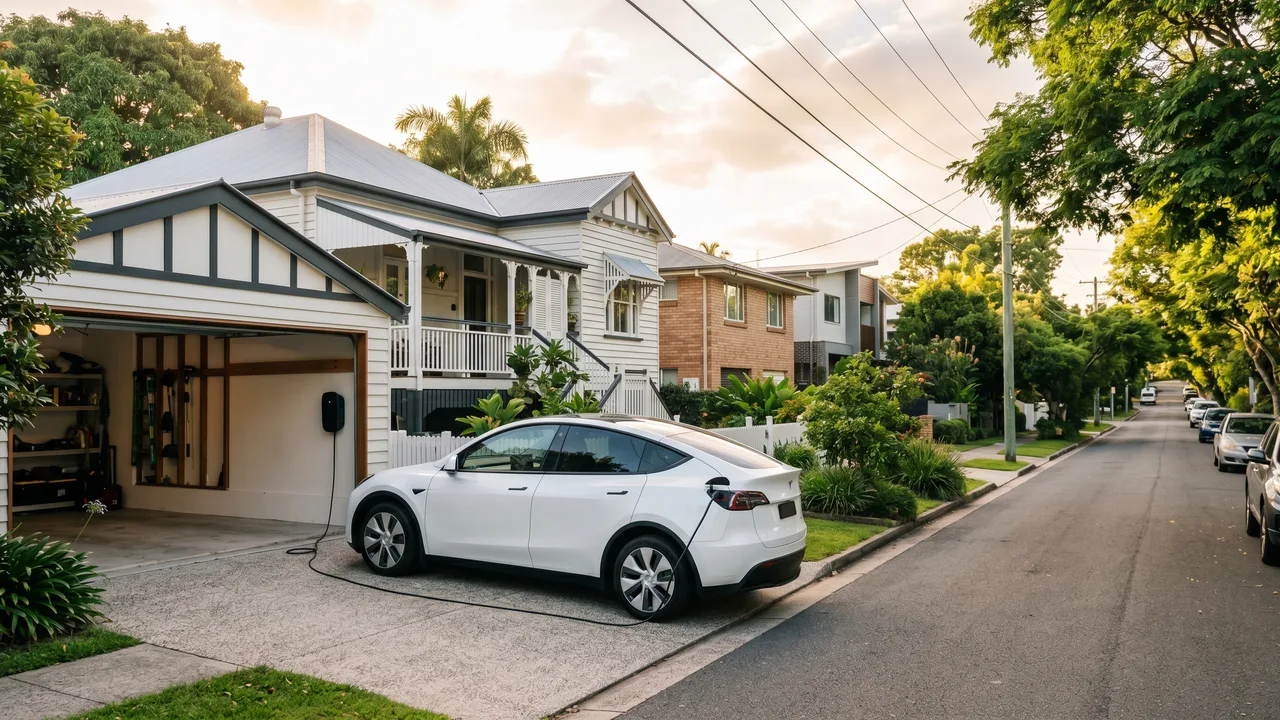
The short answer: quite a lot. The distance from your switchboard to the garage, the age of your wiring, whether you're in a freestanding house or a strata-managed unit, and even the building style typical to each suburb can all shift the scope and cost of an EV charger installation. A job in a brick-and-tile Camp Hill home with a modern switchboard in an attached garage is a straightforward half-day. The same charger fitted to a highset Queenslander in Highgate Hill with a sub-board in the laundry and 15 metres of external conduit to the carport is a different project.
Understanding those differences before you get a quote saves surprises.
The housing stock tells most of the story
Brisbane's inner south is not one uniform neighbourhood. It's a patchwork of housing eras and styles, and the suburb you live in strongly predicts what an electrician will find when they open your switchboard.
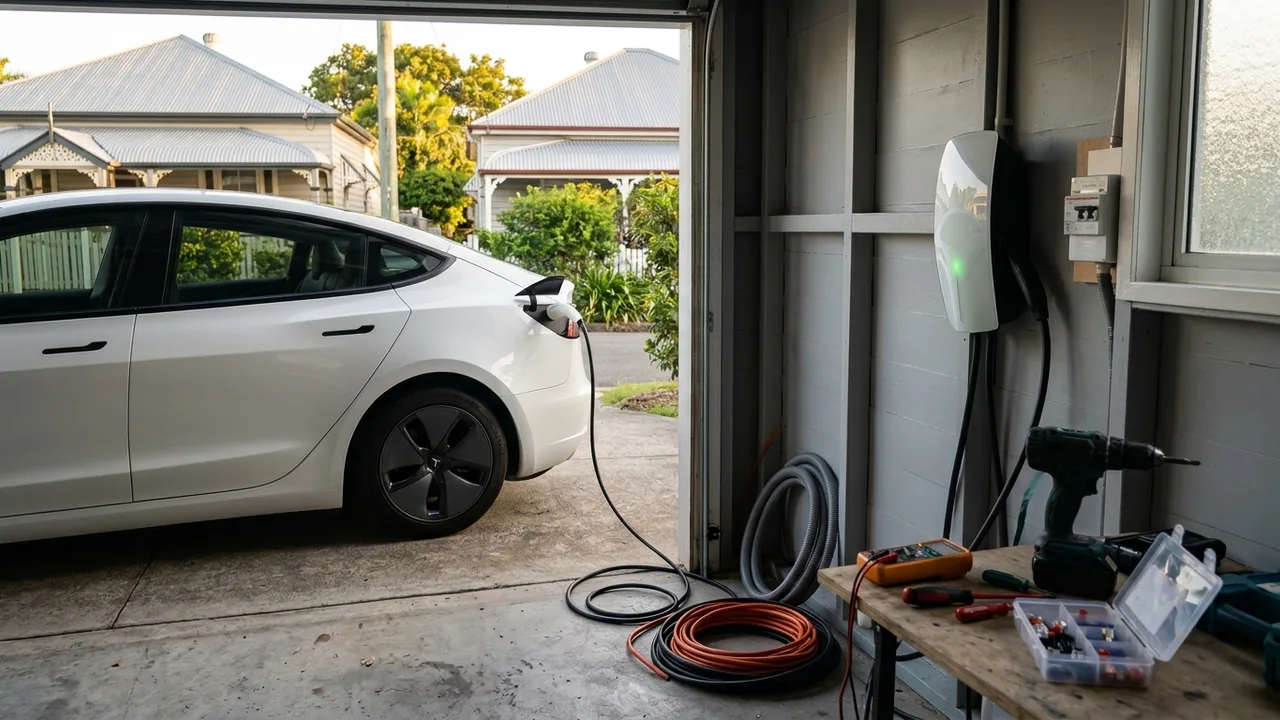
Highgate Hill, West End and Dutton Park have a high proportion of pre-1970s highset Queenslanders. Timber floors, subfloor cable runs, and switchboards that were last touched in the 1990s (or earlier) are common. In these homes, we frequently find ceramic fuse boards or older circuit breaker panels without a spare circuit for a 32A EV charger load. A switchboard upgrade is often part of the job, typically adding $600 to $1,200 to the base install cost.
Coorparoo, Camp Hill and Greenslopes lean toward post-war lowset brick homes from the 1950s through to the 1980s, plus a wave of knockdown-rebuilds from the 2000s onwards. The rebuilds usually have modern switchboards and single-phase or three-phase supply already in place, making installation straightforward. The older brick homes sometimes have double-brick walls that complicate cable routing, though most still have accessible subfloor or roof cavity paths.
Woolloongabba, East Brisbane and Kangaroo Point mix older workers' cottages with medium-density units and newer townhouses. The units and townhouses raise strata questions (covered below). The cottages share the same aging-board pattern as West End. Kangaroo Point apartments are particularly common, and several buildings there have body corporate committees that are only now starting to develop EV charging policies.
South Brisbane and Annerley sit somewhere in between, with a mix of character homes and infill townhouses. Annerley, in particular, has a lot of solid 1960s brick homes where the garage is attached and the cable run is short. That's often the easiest install in the cluster.
Tarragindi is predominantly freestanding lowset homes, many owner-occupied for decades. Switchboards here are a mixed bag. We see more single-phase supplies and older boards in Tarragindi than in some suburbs closer to the CBD.
Cable runs: why distance and wall type matter
The physical path from switchboard to charger location is where suburb-specific factors hit your quote hardest.
A charger installed within 10 metres of the switchboard, with a clear path through a roof cavity or subfloor, is a routine job. As that run extends to 20 or 30 metres, labour time increases and conduit costs add up. On a highset Queenslander in Highgate Hill, the cable might travel from a sub-board in the kitchen, down through the subfloor, along the underside of the deck and into an exposed carport post. That's real conduit length, and it needs to be weatherproofed.
Brick veneer and double-brick homes (common in Greenslopes and parts of Coorparoo) occasionally require surface-mounted conduit on external walls rather than chasing into the masonry. Surface conduit is not necessarily ugly if done neatly, but it is worth discussing with your installer before the job starts so you're not surprised on the day.
Timber-framed homes (most of the Queenslanders) are generally more cable-friendly. The framing allows concealed runs in walls and ceiling cavities, which looks cleaner and is quicker to pull through.
Apartments and strata buildings: a genuinely different process
If you're in a unit in Woolloongabba, Kangaroo Point or South Brisbane, installation is not just an electrical job. It involves body corporate approval, sometimes a special general meeting, a review of the strata title documents, and potentially a metering arrangement with your body corporate or a third-party metering provider.
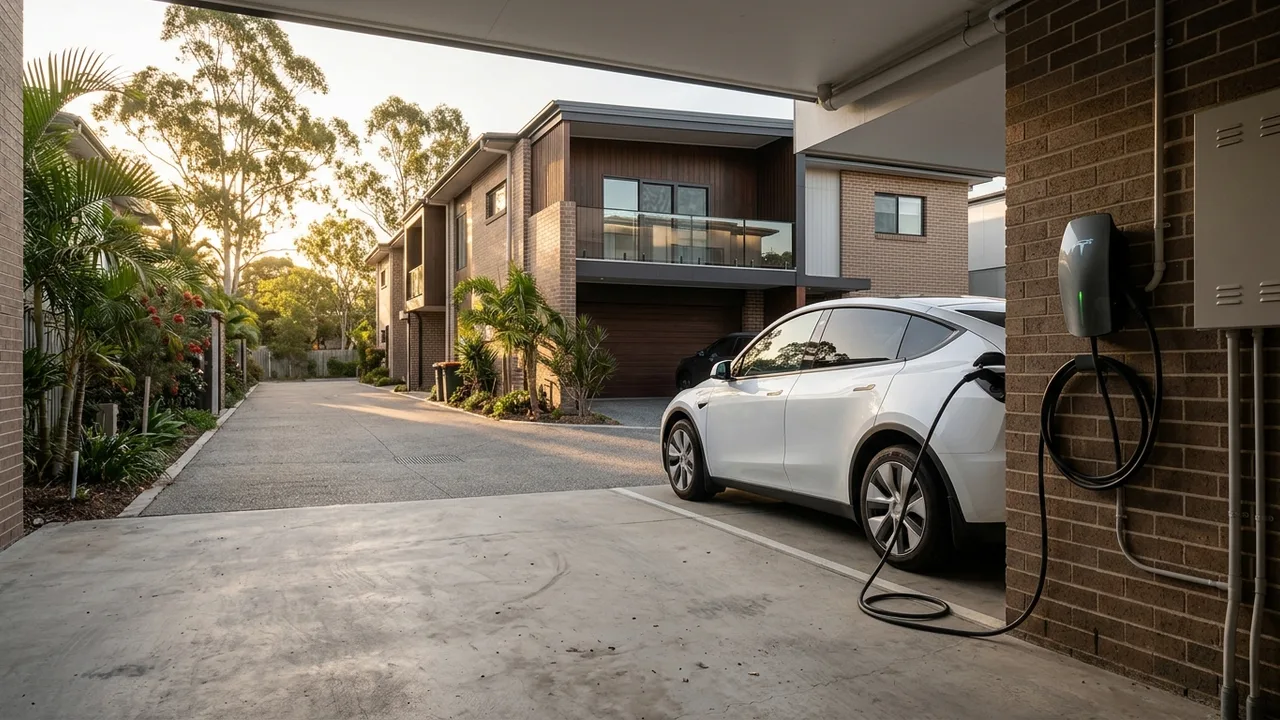
Queensland's body corporate legislation allows lot owners to install electric vehicle charging infrastructure, but the process is not automatic. A request must be submitted, and the body corporate can impose reasonable conditions around how the work is done, who pays for ongoing electricity costs, and how the charger is metered.
We handle that documentation as part of our apartment and strata installations. In practice, most approvals in well-managed buildings come through within two to six weeks. The physical installation itself is often a single morning once approvals are in hand. Costs vary more widely on strata jobs because the cable run from your dedicated circuit back to the main switchboard varies building by building. Budget $2,500 to $4,500 as a realistic range for a compliant dedicated-circuit apartment install in Brisbane's inner south.
Three-phase power: who needs it, and who doesn't
Most homes in Brisbane's inner south have single-phase power, which supports EV chargers rated up to 7.4kW. At 7.4kW, you're adding roughly 40 kilometres of range per hour of charging, which is enough for the majority of daily driving patterns.
Three-phase supply supports chargers up to 22kW. At 22kW, a full charge overnight becomes a short charge of two to three hours. That's valuable if you do high daily kilometres, if you share one vehicle between two people with different schedules, or if you simply want flexibility as your driving habits change.
The trade-off is cost. A three-phase supply upgrade where none currently exists involves work at the street level via Energex, not just on your property. That process takes longer (weeks, not days) and adds roughly $1,500 to $3,000 to the project depending on your switchboard and metering configuration. In newer rebuilds in Camp Hill and Coorparoo, three-phase is often already present because builders routinely install it now. In older homes, it usually isn't.
Honest advice: most people with a single EV charging overnight don't need three-phase. If you're replacing a second petrol car with an EV, or you're planning to install solar and a battery alongside the charger, the case for three-phase gets stronger.
Solar integration: relevant for owner-occupiers with existing panels
Brisbane's inner south has high solar uptake. In areas like Tarragindi, Greenslopes and Camp Hill, it's common to have an existing rooftop solar system (photovoltaic (PV) panels) generating surplus power during the day that currently feeds back to the grid for a low export tariff.
Linking your charger to a solar monitoring system or a "solar optimised" charger mode lets the charger draw from surplus PV generation rather than the grid. This genuinely reduces charging costs, though it works best for people who are home during the day or who can schedule charging to align with peak solar hours (roughly 10am to 3pm in Brisbane).
The integration requires either a charger with built-in CT clamp (current transformer) monitoring or a third-party energy management device. Not every charger brand supports this equally well. We size the charger and monitoring setup to match your inverter brand and solar system capacity during the quoting stage, rather than retrofitting compatibility after the fact.
If your solar system is more than eight years old, it's also worth having the inverter checked at the same time. Some older string inverters don't communicate well with modern smart chargers.
A practical recommendation before you call anyone
Before you get a quote, walk the likely cable route yourself. Identify where your switchboard is, where you want the charger mounted, and what's between them. Note whether you have a roof cavity or subfloor accessible. Check whether your switchboard has visible ceramic fuses or modern circuit breakers. Take a photo and send it to your installer before the site visit. That one step tends to produce faster, more accurate quotes and fewer surprises on the day.
If you're in a unit, pull out your body corporate contact details. You don't need approval in hand before talking to an electrician, but knowing your committee's usual response time helps with planning.
The installations across Coorparoo, Camp Hill, West End and the surrounding suburbs aren't all the same job. The difference between a clean, correctly specced install and a rushed one that creates problems later often comes down to how thoroughly the site is assessed before anyone picks up a drill. A good quote takes 20 to 30 minutes on site. If someone quotes you entirely over the phone without asking about your switchboard, cable path or whether you have solar, treat that as a yellow flag.
Quick answers