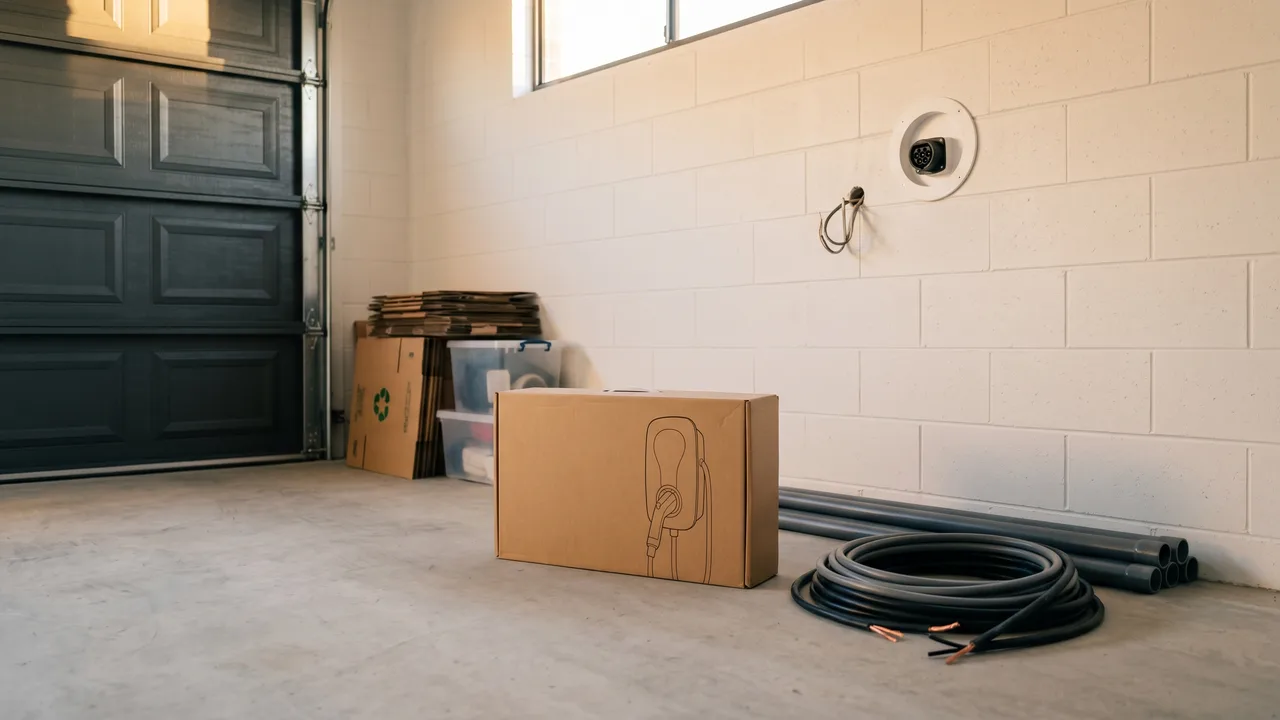
EV Charger Installation guide
Can you install your own EV charger, or does Queensland law require a licensed electrician?
The Short Answer
No, you cannot legally install your own EV charger in Queensland if it involves any electrical wiring work. Queensland law requires a licensed electrician to carry out all electrical wiring, including the dedicated circuit that connects a wall-mounted charger to your switchboard. Plugging a portable, plug-in charger into an existing power point is a different matter — but that comes with its own trade-offs worth understanding before you go down that path.
What Queensland Law Actually Says
The Electrical Safety Act 2002 (Qld) and the Electrical Safety Regulation 2013 govern who can perform electrical work in Queensland. Under those rules, any work that involves connecting, altering or extending fixed electrical wiring must be done by a licensed electrical contractor or a licensed worker operating under one. That covers:
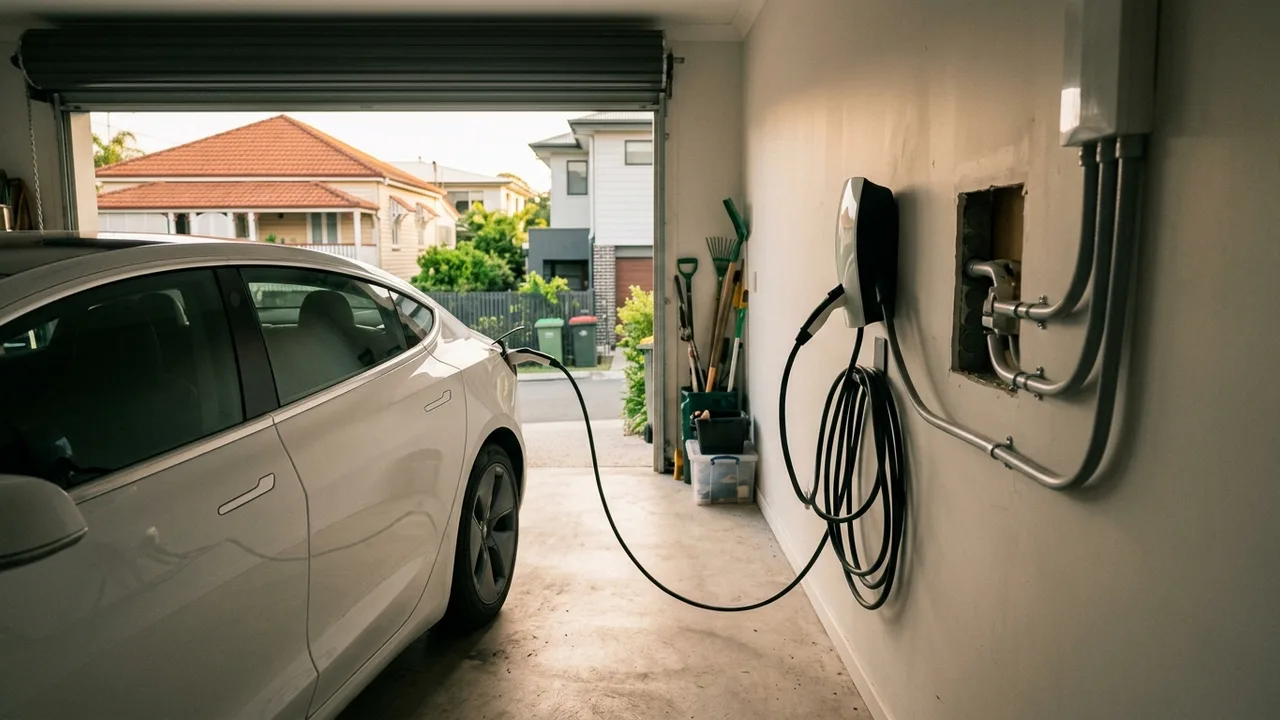
- Installing a new dedicated circuit from your switchboard to a wall-mounted charger
- Upgrading your switchboard or consumer mains board to handle the additional load
- Connecting the charger unit to that circuit
After the work is done, the electrician must issue a Certificate of Test (sometimes called a Form 9). This is the document that confirms the installation was tested and complies with Australian Standard AS/NZS 3000:2018 (the "Wiring Rules"). You need that certificate for your insurer, and potentially for warranty claims on the charger itself.
Doing the wiring yourself — even if you are handy, even if you watch every YouTube video available — is unlicensed electrical work under Queensland law. The penalty for unlicensed electrical work can reach $38,450 for an individual as of the time of writing, and that is before any insurance implications if something goes wrong.
What About Portable "Trickle" Chargers?
This is where things get a little more nuanced. A Mode 2 portable charger — the cable that typically ships in the box with your EV — plugs into a standard 10-amp household power point. Plugging in a cable yourself is not electrical work, so no licence is required for that act.
The practical problem is the charging rate. A standard 10-amp socket delivers roughly 2.4 kW, which adds around 10-15 km of range per hour depending on your vehicle. If you drive 50 km a day in and around the Inner West, you are looking at 4-5 hours on the charger overnight just to break even. That is manageable for some people, but it is marginal, and it assumes the power point is in good condition.
Here is the catch: many homes in Coorparoo, Camp Hill and Annerley still have older wiring and switchboards, particularly Queenslander-style houses that have had staged renovations over the decades. Running a sustained 10-amp draw for several hours on an ageing circuit can stress the wiring in ways that a once-a-day kettle never would. If your power point trips regularly, runs warm or the wiring is pre-2000, that trickle-charging approach is worth reconsidering even if it is technically legal.
The Case for a Dedicated Wall-Mounted Charger
A Mode 3 wall-mounted charger (also called an EVSE, or Electric Vehicle Supply Equipment) operates on a dedicated circuit, typically 7.4 kW on single-phase or up to 22 kW on three-phase power. That jump in output is significant. At 7.4 kW, a 60 kWh battery goes from near-empty to full in roughly 8 hours overnight. At 22 kW on three-phase, you are looking at under 3 hours for the same battery.
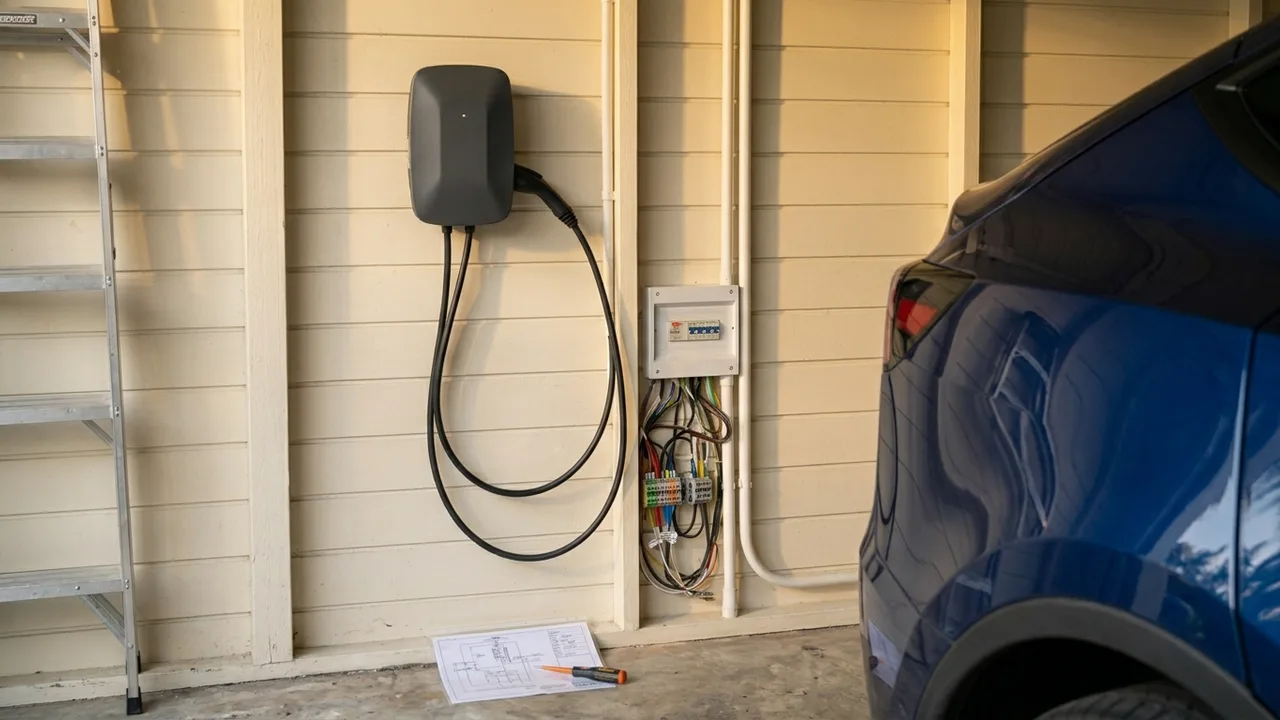
For most households in our area, single-phase installation is sufficient. Three-phase becomes worth considering if you have a longer-range EV, regularly run the battery down, or plan to add a second EV to the household.
A dedicated circuit also means the charger load does not compete with the rest of your house. No nuisance tripping, no thermal stress on a shared circuit. The charger itself is weatherproof, typically wall-mounted in the garage or carport, and many models can be scheduled to charge during off-peak tariff windows or during the day when your rooftop solar is generating.
The cost for a standard home installation in the Coorparoo area typically sits between $1,800 and $4,500, depending on:
- How far the new circuit needs to run from your switchboard
- Whether your existing switchboard needs upgrading
- Whether you are on single-phase or three-phase supply
- The charger unit selected (some homeowners supply their own, some prefer us to supply it)
Apartment and townhouse installations in areas like Kangaroo Point or West End add complexity around body corporate approvals and common-area cabling routes, which tends to push costs toward the higher end of that range.
Switchboard Considerations Specific to Older Brisbane Homes
A significant number of homes in our cluster — Highgate Hill, Dutton Park, Greenslopes, Tarragindi and the like — were built or substantially wired before modern switchboards became standard. If your switchboard still has ceramic fuses or older circuit breakers with no residual current devices (RCDs), it will likely need upgrading before any EV charger circuit can be legally installed.
This is not a sales tactic; it is a compliance reality. AS/NZS 3000:2018 requires appropriate overcurrent and RCD protection on new circuits. An electrician inspecting the board before quoting will tell you whether an upgrade is needed. Some boards need only an additional MCB slot; others need a full replacement consumer mains board.
A switchboard upgrade adds to the upfront cost, but it also brings the rest of your electrical system up to a safer standard — which can matter for home insurance and for any future solar or battery installation.
Solar Integration: Worth Planning for Now
If you have an existing rooftop solar system, or you are planning one, it is worth mentioning that to your electrician before the charger is installed. Some EV chargers can be configured to draw preferentially from surplus solar generation during the day rather than importing from the grid. This typically requires a compatible charger model and either a solar-aware inverter or a separate energy management device.
We set up solar-integrated EV charging for homes across the Inner West fairly regularly, and the key point is this: it is much easier to plan the integration from the start than to retrofit it later. If the conduit runs and switchboard connections are made with integration in mind, you avoid a second round of work down the track.
The economics vary. If you are on a flat-rate tariff and your solar system regularly generates surplus midday power that you would otherwise export for a low feed-in rate, charging your car on that surplus instead can represent a meaningful saving over time. If you are a commuter who leaves early and returns late, the solar window may not overlap with your charging window anyway — and time-of-use tariff scheduling might serve you better.
Our Honest Recommendation
If you are serious about home EV charging, a proper wall-mounted charger on a dedicated circuit is the right long-term setup. The trickle-charge approach works as a short-term stopgap, but it is not designed for nightly use as a primary charging method, and in older Brisbane homes it carries risks that are easy to underestimate.
Get the electrical work done by a licensed electrician who issues a Form 9 at completion. Keep that certificate. Check that your switchboard is adequate before committing to a charger model. And if you have solar, have the conversation about integration before the installation day, not after.
We cover Coorparoo and the surrounding Inner West and Inner South suburbs. If you want a quote, or just want someone to come out and look at your switchboard and tell you honestly what your home needs, that is a straightforward conversation. No pressure, no package upsells — just an accurate scope before you decide anything.
Quick answers