EV Charger Installation guide
What drives the cost of EV charger installation in Brisbane's inner south?
What drives the cost of EV charger installation in Brisbane's inner south?
The short answer: cable run length, your existing switchboard capacity, and whether your home has single-phase or three-phase power. Those three factors alone account for most of the price variation we see across Coorparoo, Camp Hill, Woolloongabba and the surrounding inner-south suburbs. Everything else, charger brand, permit fees, the shape of your roof cavity, adds smaller amounts on top.
Here is what each factor actually means in practice, and how to figure out where your own job is likely to sit.
Your switchboard is the starting point
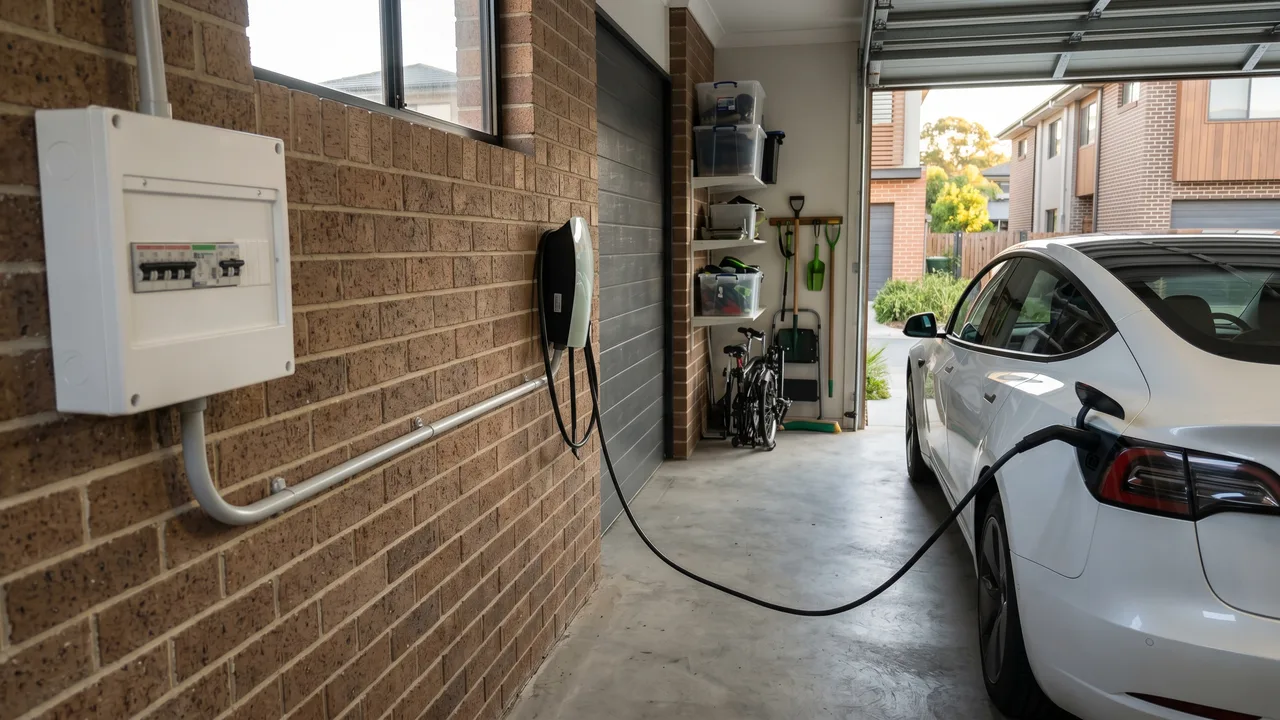
Before a charger goes on your wall, a licensed electrician has to confirm your switchboard can handle the extra load. A 7kW wall charger draws around 32 amps continuously. Older homes in this part of Brisbane, and there are plenty of them, often have ceramic fuse boards or switchboards rated to 60 or 80 amps total. Those boards were never designed to take a permanent high-draw appliance running for six to eight hours overnight.
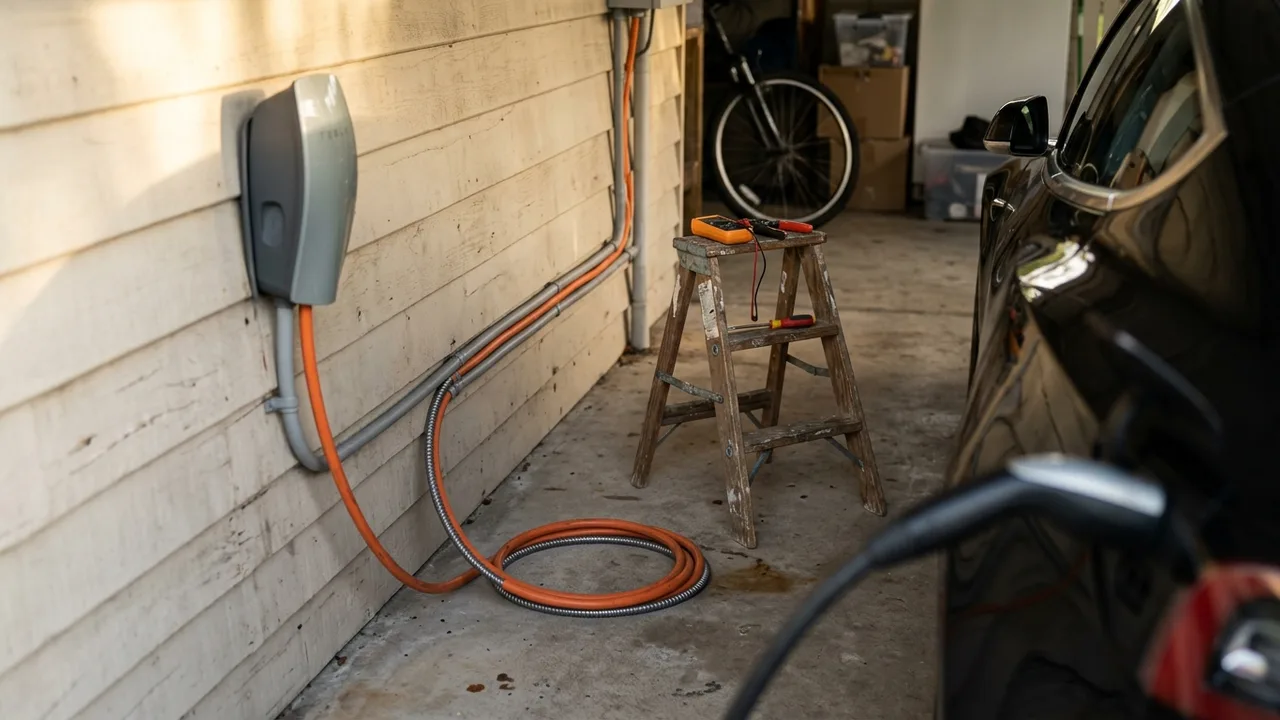
If your switchboard is already a modern circuit-breaker board with spare capacity, installation is straightforward and cheaper. If it needs replacing, budget an extra $800 to $1,500 typically, depending on board size and complexity. That is not a nasty surprise; it is work that needed doing anyway, and a switchboard upgrade makes your whole home safer and more insurable.
A related question is whether you have three-phase power. Most detached homes in Coorparoo, Annerley, Tarragindi and Greenslopes are single-phase. That is fine for a 7kW charger. If you want to run a faster 11kW or 22kW charger, you need three-phase supply. Upgrading from single-phase to three-phase involves Energex, a network connection application, and typically $1,000 to $2,500 in additional costs. It is worth doing if you drive heavily or own two EVs, less worth it if you cover 50km a day and a 7kW charger will top you up overnight regardless.
How far the cable has to travel
Inner-south Brisbane is a mix of post-war brick-and-tile, Queenslanders on stumps, and infill townhouses. Each presents a different cabling challenge.
On a Queenslander with an open subfloor, running cable from the switchboard to a garage or carport is relatively easy. Access is good, the run is often short, and the job stays tidy. On a brick slab home where the switchboard is at the front and the garage is at the rear, that cable might travel 20 to 30 metres through a wall cavity or under a concrete slab. Conduit, labour time, and penetrations add cost, sometimes $300 to $600 extra on longer runs.
Townhouses, which are common in West End, South Brisbane, Highgate Hill and Kangaroo Point, often have the switchboard in a cupboard on one floor and the car space at ground level. Routing through a stairwell or an internal wall takes time. That is before you factor in body corporate approvals if the property is strata-titled (more on that below).
The take-away: when you ask for a quote, walk the electrician from the switchboard to where the charger will go. The route matters as much as the destination.
Charger choice and what it actually changes
The charger unit itself typically costs $400 to $1,200 for a quality 7kW single-phase model. Brands vary, and the main differences are build quality, app connectivity, load-balancing features and warranty length. A basic tethered unit with a fixed cable is fine for most households. A smart charger with Wi-Fi, solar integration compatibility, and scheduled charging costs more upfront but gives you more flexibility.
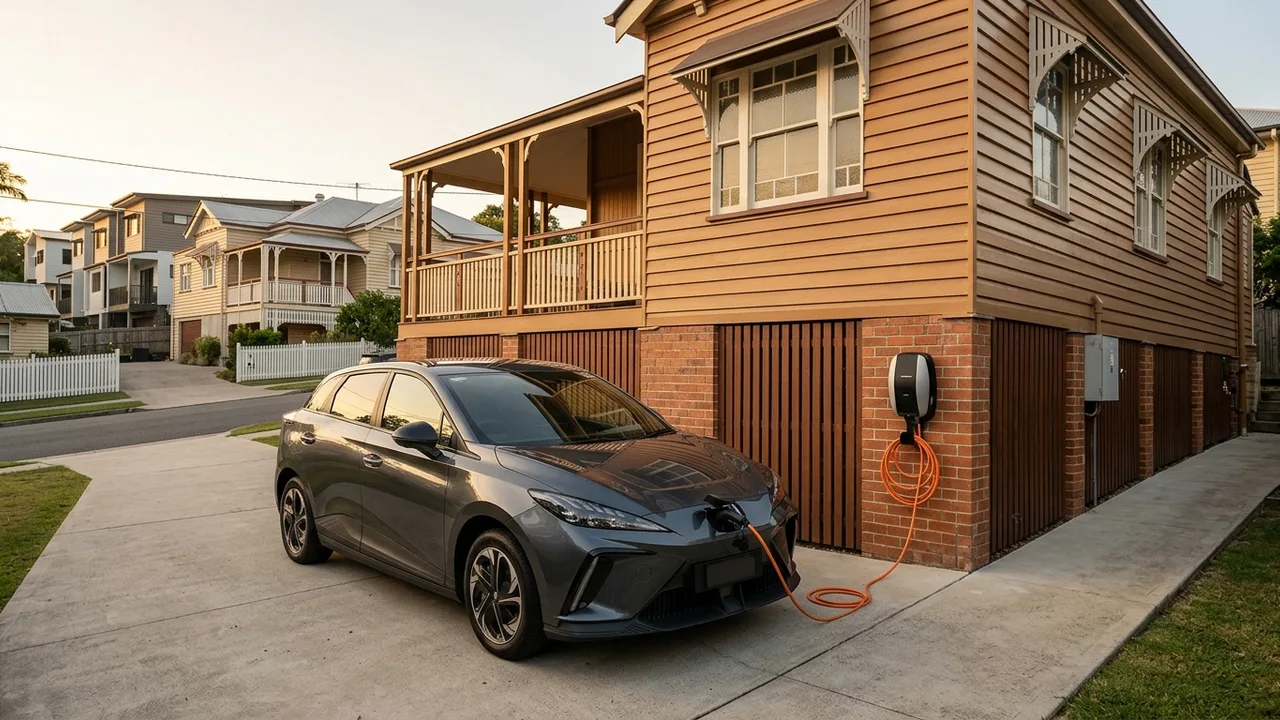
One trade-off worth thinking about: tethered versus untethered. A tethered charger has the cable permanently attached, which is convenient day-to-day. An untethered (socket-only) charger lets you use the cable that came with your car, which is useful if you own vehicles from different manufacturers or plan to change cars. Either way, the installation cost is similar. The choice is really about how you use the car.
Load management is worth paying attention to if your household already runs a ducted air conditioner, electric oven, or other heavy appliances. A smart charger with dynamic load management can throttle charging speed automatically to avoid tripping your main breaker. On a busy circuit that is a practical feature, not a marketing gimmick.
Solar integration: when it makes sense, when it does not
Many homes across Camp Hill, Coorparoo and Tarragindi already have rooftop solar. Linking your EV charger to charge on surplus solar generation sounds ideal, and it often is, but there are conditions.
For solar-integrated charging to work well, you need a smart charger that communicates with your inverter or a home energy management system. The charger needs to see how much surplus power the system is exporting and modulate charging accordingly. This typically adds $200 to $500 to installation costs (additional wiring, configuration, and sometimes a current transformer clamp).
The honest trade-off: if you work from home, your EV sits in the driveway during peak solar hours and charges for close to nothing. If you commute and the car is never home between 9am and 3pm on weekdays, solar-integrated charging gives you much less benefit. In that case, a smart charger set to charge on the overnight off-peak tariff (if your retailer offers one) may save you more money for less upfront complexity.
Apartment and strata installations in the inner south
Dutton Park, Woolloongabba, East Brisbane and Kangaroo Point all have a significant proportion of apartments and strata-titled townhouse complexes. Installing an EV charger in these situations is more involved than a standalone house, but it is absolutely doable.
The main steps are: identify your dedicated car bay (not all bays can take a charger easily), assess the power supply to the carpark, get body corporate approval, and install a circuit that is separately metered so you are billed only for your own charging. Each step adds time and sometimes cost. Body corporate approvals can take weeks. Metering adds hardware. Conduit through a carpark adds labour.
We handle the body corporate paperwork end to end for strata jobs. That is not a luxury; without correct approval and metering, a future owner can be asked to remove the charger at their own expense. Getting it done properly once is cheaper than fixing it later.
Expect a strata installation to cost more than a house installation, typically $2,500 to $4,500 depending on cable run and metering requirements. Some buildings have centralised EV charging infrastructure already roughed in, which can reduce costs significantly.
Permits, inspections and what the law actually requires
In Queensland, all EV charger installations must be done by a licensed electrical contractor and require a Compliance Certificate (Form 4) issued to the homeowner. This is not optional paperwork; it is your legal record that the work meets AS/NZS 3000 wiring standards. Any reputable installer includes this in their quote. If a quote does not mention a compliance certificate, ask about it before you accept.
An inspection is also worth considering if you have an existing charger installed by a previous owner or a builder's electrician you are not sure about. We offer a standalone compliance check for exactly this situation: a licensed look at the wiring, earthing, circuit protection and installation method, with a written report. That typically costs $150 to $300 and can save you a much larger bill if an insurer ever queries the installation after an incident.
A closing thought
The typical installed cost for a home EV charger in Brisbane's inner south runs from around $1,800 for a straightforward job on a modern switchboard to $4,500 or more when switchboard upgrades, long cable runs, three-phase work or strata approvals are involved. Most jobs land somewhere in the middle.
The best thing you can do before booking is to take five minutes and look at where your switchboard is, note the distance to where you park, and check whether your home is single-phase or three-phase (it is printed on your main switch). Share that information when you ask for a quote and you will get a more accurate number first time.
We cover Coorparoo and the surrounding inner-south suburbs including Camp Hill, Greenslopes, Annerley, Tarragindi, Woolloongabba, West End, Highgate Hill, South Brisbane, Dutton Park, Kangaroo Point and East Brisbane. If you want a written quote with no obligation, a quick phone call or email with a photo of your switchboard is usually enough to get started.
Quick answers