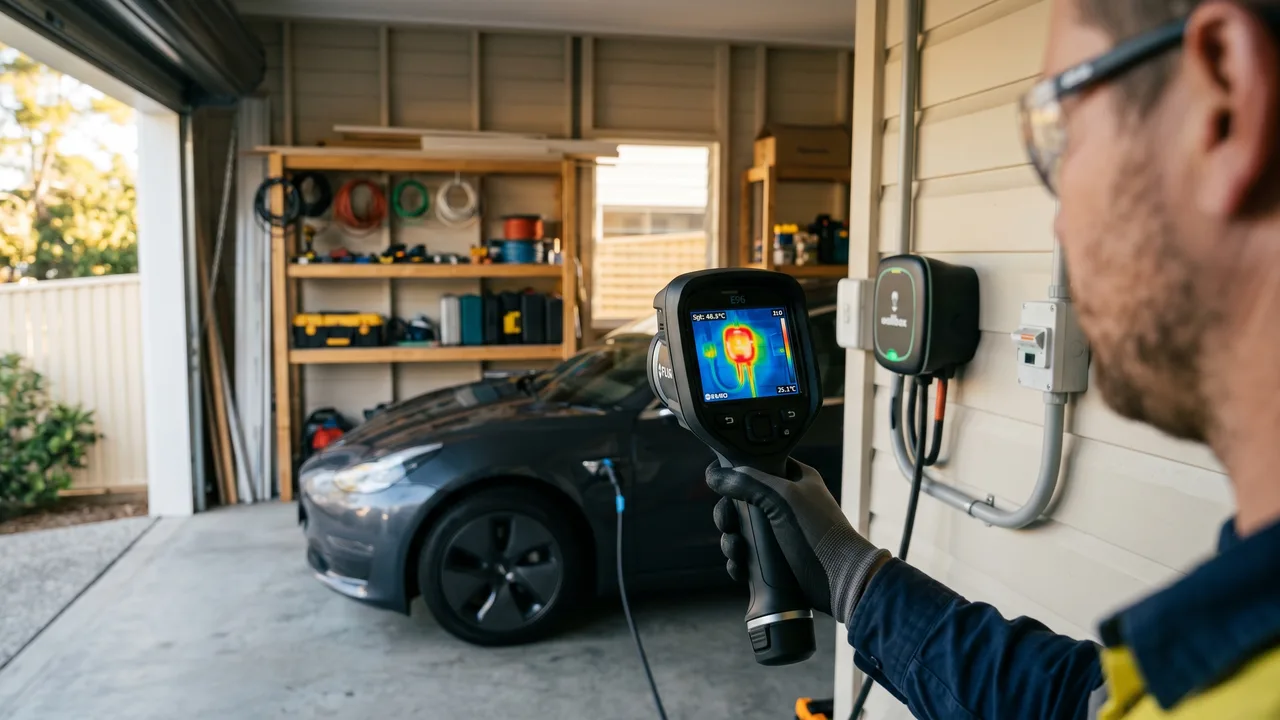
EV Charger Installation guide
What goes wrong with EV charger installations, and how do you avoid it?
What Goes Wrong With EV Charger Installations, and How Do You Avoid It?
Most problems with EV charger installations come down to three things: an underpowered switchboard, wiring that was never designed for a continuous high load, and assumptions made without a proper site inspection. Fix those three things upfront, and the rest tends to go smoothly.
That said, the details matter, and the details vary depending on your home, your suburb, and your network connection. Here's what we actually see go wrong on jobs across Coorparoo, Camp Hill, Greenslopes, West End, and the rest of our service area, and what you can do to steer clear of the same headaches.
The Switchboard Is the First Thing to Check
The single most common issue we see is a switchboard that simply isn't ready for a 7.2 kW or 11 kW charger load. Older homes in inner Brisbane, particularly the pre-1980s Queenslanders and post-war brick houses common in Annerley, Tarragindi, and Highgate Hill, often have ceramic fuse boards or early circuit-breaker boards with no room for a dedicated circuit.
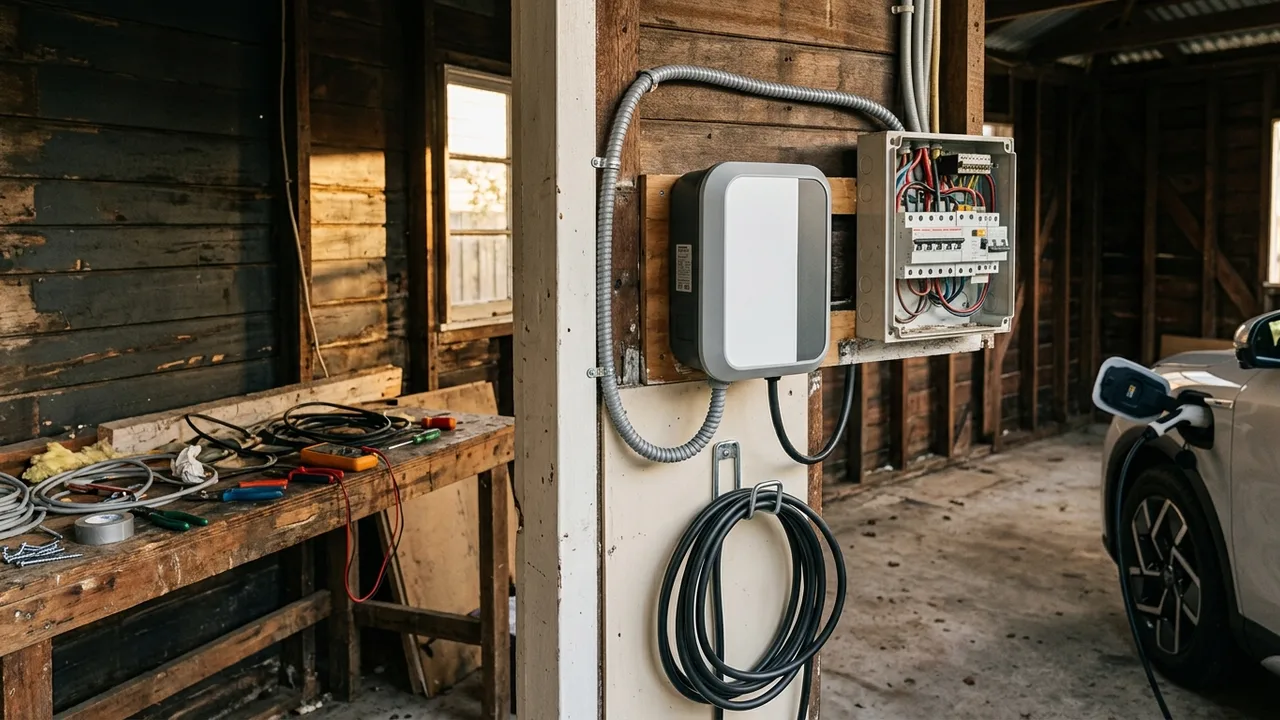
A 7.2 kW charger draws roughly 30 amps continuously for several hours. That is not a kettle. It needs a dedicated circuit with appropriate cable sizing, a proper circuit breaker rated for the load, and residual current device (RCD) protection. If your existing board can't accommodate that, you are looking at a switchboard upgrade before the charger even goes on the wall.
The cost difference is real. A straightforward wall-mount charger installation in a house with a modern board typically sits in the $1,800 to $2,500 range. Add a switchboard upgrade and you're typically looking at $2,500 to $4,500 depending on the scope. That's not a hidden extra, it's just the reality of bringing older infrastructure up to the AS/NZS 3000 wiring standard. Any electrician who doesn't mention the switchboard during a quote is missing a step.
Wrong Cable Run: When the Garage Is Not Where You Think It Is
The second issue is underestimating the cable run. A charger bolted to the wall of a detached garage, a carport on the side of a Highgate Hill block, or a shared car bay in a Woolloongabba apartment building all require a cable route from the switchboard. That route might be straightforward. It might not be.
In older homes, the garage is often at the back of a sloping block, with no existing conduit and a long run through the subfloor or along an external wall. The longer and more complex the run, the more cable, the more conduit, and the more labour. A 15-metre run buried in conduit along a brick wall costs more than a 5-metre run through a modern garage with cable tray already in place.
The honest trade-off here is time versus money. A good electrician will walk the route with you before quoting. If someone quotes you over the phone without seeing the property, the quote is either padded to cover unknowns or it will change when they see the site.
Single-Phase Limitations and When Three-Phase Actually Helps
Most Brisbane homes run on single-phase 240V power. A single-phase 32-amp circuit tops out at around 7.2 kW of charging, which adds roughly 40 to 45 kilometres of range per hour for most EVs. For most households, that's fine: you plug in overnight and wake up to a full battery.
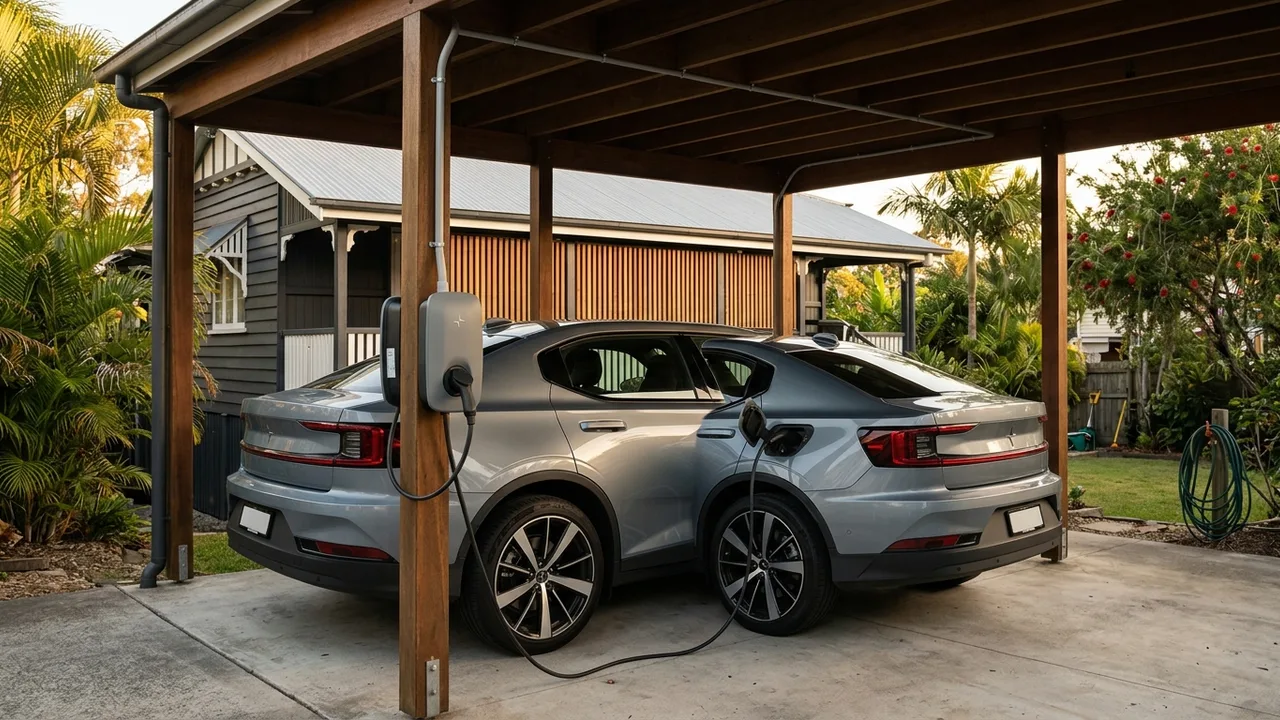
Where it becomes a problem is if you have a larger EV (some models have 11 kW or 22 kW onboard chargers), or you drive a lot of kilometres in a day, or you want to charge during the day from solar rather than overnight from the grid.
Three-phase power, where it's available on your street, allows an 11 kW or 22 kW charger to work at full speed. In practice, 11 kW is the sweet spot for home charging. If your property in Coorparoo or East Brisbane already has three-phase (common in homes that previously ran large air conditioning systems, pool pumps, or workshop equipment), you may just need the right charger and a dedicated circuit. If you don't have three-phase, Energex will need to connect it at the street, and that involves a separate application, a lead time, and a cost that varies.
Don't assume three-phase is always necessary. Get clear on your actual daily driving distance and your car's onboard charger rating before spending money on a three-phase upgrade you won't fully use.
Apartments and Strata: A Different Set of Problems
Apartment installations in suburbs like Kangaroo Point, South Brisbane, and Dutton Park involve a layer of complexity that detached-house jobs don't. You need body corporate approval before any work begins, the electrical supply in a common car park is usually metered differently to individual units, and sub-metering the charger so you're only billed for the power you use requires additional hardware.
The most common mistake here is ordering a charger before sorting the approval. We've seen owners waiting months while a charger sits in a box, because the body corporate process takes longer than expected.
The other issue is load balancing in shared basement carparks. If three residents in the same building all plug in at 7pm, and the building's main supply isn't sized for that, you get tripped circuits. A proper installation uses a smart charger with load management capability that throttles output if the building supply is under pressure.
If you're in a strata situation, expect the process to take longer, cost more, and involve more back-and-forth than a house job. That's the honest answer.
Solar Integration: Useful But Not Automatic
A lot of people assume that having solar panels means their EV charges for free. It can work that way, but only if the charger is set up to use surplus solar generation, and only if your solar system produces enough excess during the day to actually charge the car.
In inner Brisbane, a typical 6.6 kW rooftop solar system on a north-facing roof might produce 4 to 5 kW of usable surplus on a clear day, once the house's base load is covered. A 7.2 kW charger draws more than that on its own. So unless you have a larger system, a battery, or a charger that can modulate its output down to match available solar (sometimes called "solar-only" or "eco" mode), you'll always be drawing some grid power.
The trade-off is charger cost. A basic smart charger with app control and scheduling costs less than one with full solar CT-clamp integration and dynamic load management. If your goal is to genuinely minimise grid use, the more capable (and more expensive) unit earns its cost back over time. If you mostly charge overnight on an off-peak tariff, a simpler unit is probably fine.
Compliance and Sign-Off: Don't Skip This Step
Every EV charger installation in Queensland must be done by a licensed electrician and must result in a Certificate of Test (CoT) under the Electrical Safety Act 2002. The charger must also comply with AS/NZS 3000 wiring rules.
This matters more than it sounds. Home insurance policies increasingly ask about modifications to electrical systems, and an uncertified installation could give an insurer grounds to complicate a claim. If you're selling the property later, an undocumented charger installation can come up in a building inspection.
If you bought a home with a charger already installed, or had work done by someone who didn't provide paperwork, a compliance inspection is worth doing. It's a straightforward job: a licensed electrician checks the wiring, earthing, RCD protection, and cable sizing, and issues a report on what's compliant and what, if anything, needs attention.
The Practical Upshot
The problems above are all avoidable with one consistent habit: don't skip the site inspection, and don't let a charger brand or a slick website substitute for a conversation with a local electrician who has actually looked at your property.
If you're in Coorparoo, Camp Hill, Greenslopes, or any of the surrounding suburbs, the terrain, the age of the housing stock, and the varying Energex network conditions all affect what your installation actually involves. Get a quote that reflects your specific property, not a national average.
If you'd like a plain-talking assessment of what your home needs, we're happy to walk through the site with you before anything is committed to.
Quick answers