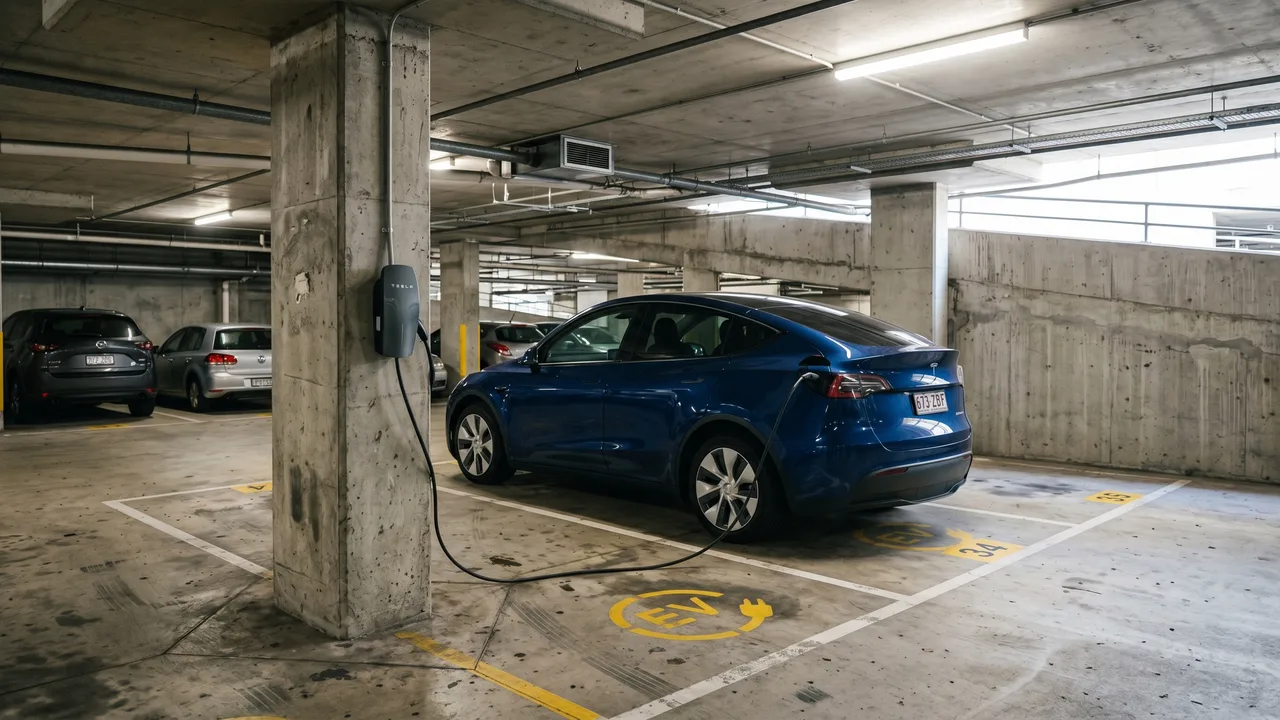
EV Charger Installation guide
Can you install an EV charger in a Brisbane apartment without body corporate drama?
Yes, You Can. But There Are Steps Involved
The short answer is yes, apartment residents in Brisbane can legally install a dedicated EV charger in their parking bay. The longer answer is that you will almost certainly need body corporate approval first, and getting that approval takes some preparation. Done properly though, it is very achievable, and we see it happen regularly across the inner-city and inner-south suburbs we work in.
Why Body Corporate Approval Is Not Optional
In a strata-titled apartment building, your car park is usually either a lot on your title or common property you have exclusive use of. Either way, running a new electrical circuit to that space almost always touches common property in some form, whether that is conduit through a shared basement, a connection to the building's main switchboard, or a cable tray along a shared wall.
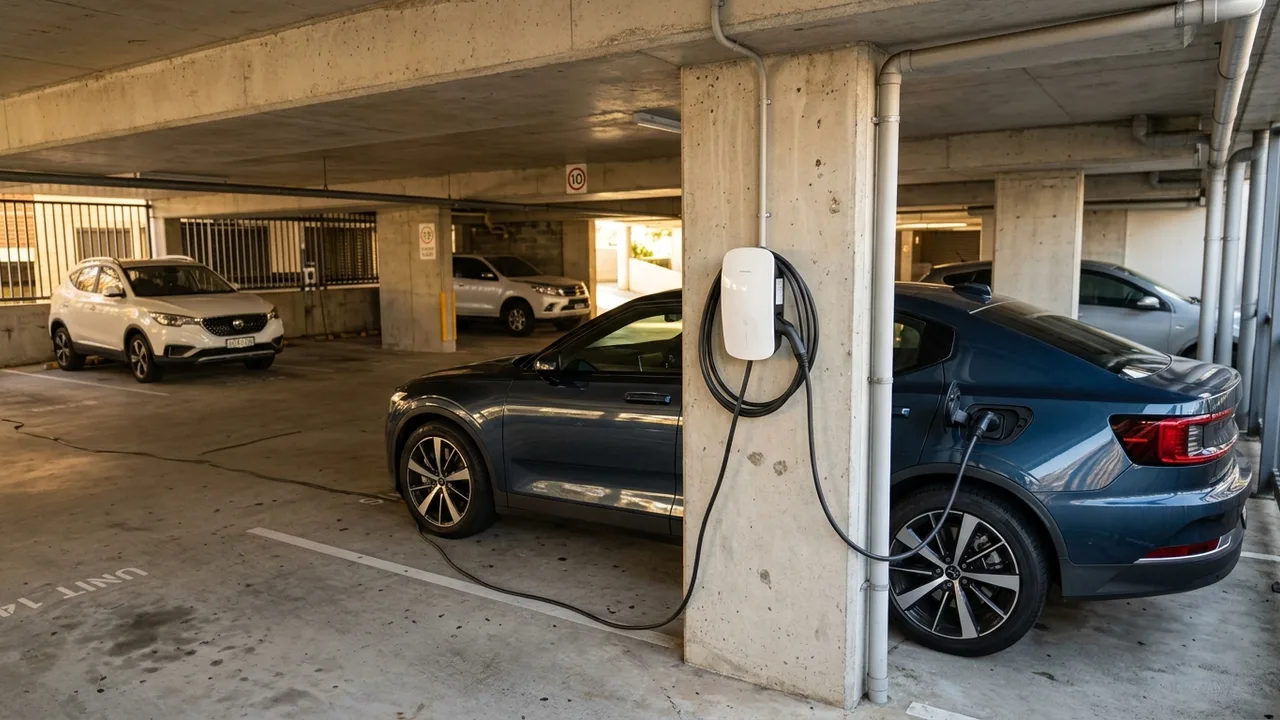
Under the Body Corporate and Community Management Act 1997 (Queensland), any improvement that affects common property requires body corporate approval. This is not a loophole or an administrative technicality. It is the law. Starting work without it puts you at risk of being ordered to remove the installation at your own expense. So step one is always the formal request, not the drilling.
The good news is that Queensland's legislation leans in your favour. Body corporates cannot unreasonably refuse a request for an EV charger improvement, particularly since 2023 when attitudes and policy guidance shifted noticeably toward EV infrastructure. "Unreasonably" still leaves room for genuine concerns about electrical capacity and cost allocation, but a well-prepared application will address those before the committee even raises them.
What a Strong Application Actually Looks Like
A weak application is a cover letter asking for permission. A strong one gives the body corporate everything they need to say yes confidently. That typically means:
- A licensed electrical assessment of the building's existing switchboard and distribution board capacity. This tells the committee whether your charger adds load the building can handle without upgrades.
- A written scope of works detailing the cable route, conduit type, metering arrangement, and make and model of the charger unit.
- A cost allocation plan clarifying who pays for what. You are responsible for the charger and its dedicated circuit. If the building switchboard needs any modification, the question of who pays for that has to be answered upfront.
- Your proposed metering solution. This is the part most applicants overlook. Your charger needs its own sub-meter so your electricity consumption is billed to you, not spread across the building's common area power account. A sub-meter (or a charger with built-in energy measurement exported to you monthly) is usually the thing that unlocks approval.
We handle the assessment and scope documentation as part of our apartment installation service. It removes the back-and-forth that stalls a lot of applications.
The Practical Electrical Reality in Brisbane Apartment Basements
Older apartment buildings around Kangaroo Point, West End, South Brisbane and Woolloongabba often have switchboards that were designed before EVs existed. That sounds obvious, but the practical consequence is real: the total electrical capacity of those buildings is sometimes already close to its limit, and adding a 7.2 kW or 11 kW charger circuit per apartment is not always straightforward.
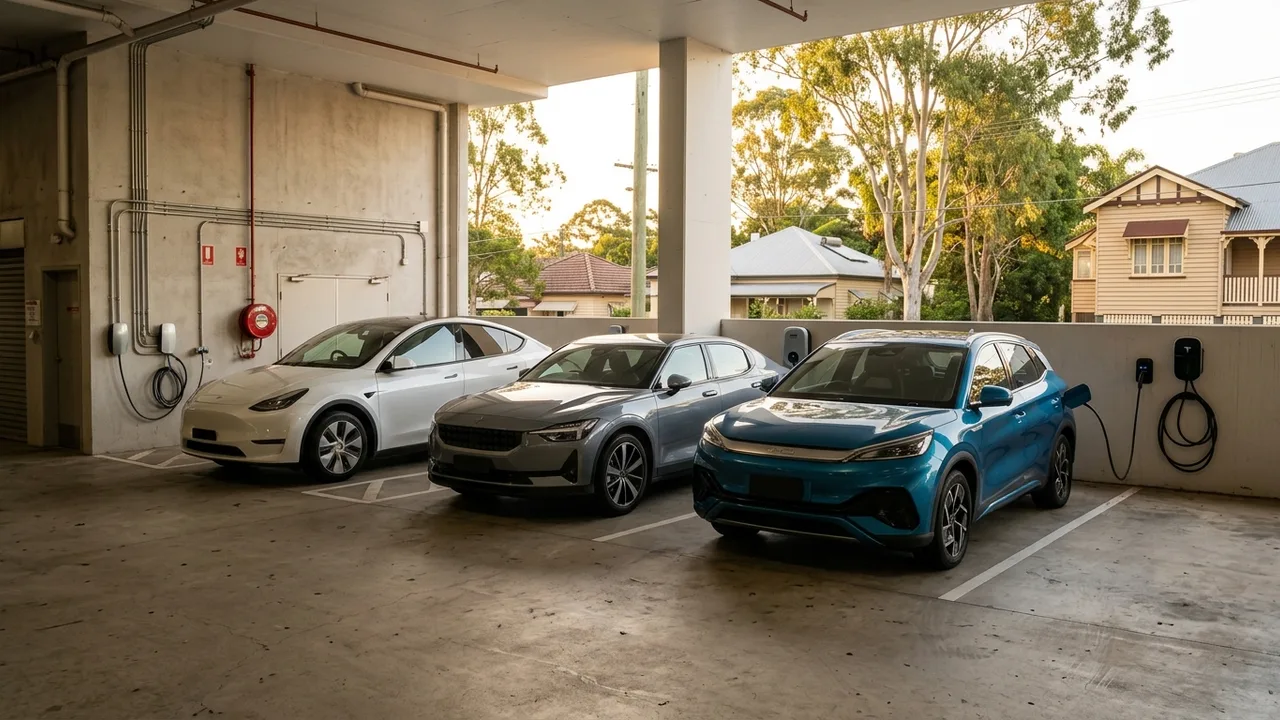
A few things that commonly come up in basements we assess:
- Long cable runs. In a multi-storey building, running a dedicated circuit from the main distribution board to a basement bay can be 30-60 metres or more. Cable sizing matters here because voltage drop across a long run reduces your actual charging speed. A properly sized circuit (typically 6mm² or 10mm² cable depending on the run and charger rating) keeps that under control.
- Conduit routing through fire-rated walls. Brisbane apartments built after about 2004 have passive fire protection in basement walls. Any penetration has to be sealed with rated fire-stopping material. This is not optional and adds a little time to the job.
- Meter board access. Some older buildings in Highgate Hill or Dutton Park have meter rooms managed by Energex (now Energy Queensland). Access for a sub-meter installation may require a metering coordinator, which adds a step to the timeline but is entirely manageable.
None of these things make an installation impossible. They just affect the scope and the cost. Our quotes itemise each element so you are not guessing.
Charger Choice for Apartment Living: What Actually Makes Sense
You have two realistic options for a dedicated home charge in a parking bay.
A single-phase 7.2 kW charger (32A circuit) is the most common choice. It will add roughly 40-50 km of range per hour of charging on most EVs. Overnight charging from a typical commuter low is fully covered. The circuit is straightforward, and most Brisbane apartment buildings can accommodate one without a switchboard upgrade.
A three-phase 11 kW or 22 kW charger charges faster but requires three-phase supply to your bay. Most apartment buildings have three-phase supply to the main switchboard, but distributing three-phase to an individual parking bay is a more involved job and usually more expensive. It makes sense if you are charging a large-battery vehicle and doing high-mileage driving, but for most city commuters it is overkill.
A note on shared charging infrastructure: some body corporates prefer a building-wide solution where several chargers are installed together on a load-managed system, with costs shared or recovered through a pay-per-use arrangement. If you are the first person in your building to raise EV charging, planting that seed in your application is worth doing. A building-wide approach often costs less per resident than individual installs and tends to get approved faster because it is neater for the committee to manage.
Cost and Timeline: What to Expect in the Inner South
For a typical single-phase 7.2 kW charger in an apartment basement across the suburbs we cover, including Coorparoo, Camp Hill, Annerley, Greenslopes and the inner-west cluster, you are typically looking at $1,800 to $3,500 all up for supply and installation. That range accounts for cable run length, conduit complexity, and sub-metering requirements. Longer runs, fire-stopping, or metering coordinator involvement can push toward the upper end.
Timeline from first contact to a live charger is typically four to ten weeks, with most of that time sitting inside the body corporate approval process rather than the physical install. The electrical work itself, once approved, is usually a one-day job.
A few things that affect cost:
- Charger brand and model (a reliable branded unit with a three-year warranty sits in a different price bracket to a no-name unit)
- Whether your switchboard needs any work before the circuit can be added
- The number of fire-rated penetrations required along the cable route
We are transparent about this in quotes. If an assessment turns up something that changes the scope, we tell you before any work starts.
A Practical Path Forward
If you are an apartment resident in the inner south or south Brisbane area and you want an EV charger in your bay, start with the body corporate process, not the shopping cart. Get a licensed electrical assessment done first so your application is backed by facts rather than assumptions. A well-documented application shortens committee deliberation significantly.
If your body corporate has already approved a scheme and you just need the physical work done, we can move straight to quoting. Either way, the conversation starts with a quick look at your setup: parking bay location, estimated cable run, and building switchboard type.
There is no reason apartment living should mean slow AC charging from a three-pin power point on extension leads across the floor. A dedicated circuit is safer, faster, and better for your battery. It just takes a bit of process to get there.
If you want a straight answer on whether your specific building and parking situation is workable, give us a call. We can usually tell you a lot from a photo of the distribution board and a rough description of the cable route.
Quick answers